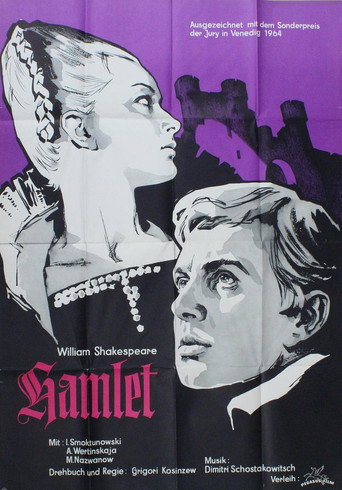
Гамлет (1964)
Shakespeare's 17th century masterpiece about the "Melancholy Dane" was given one of its best screen treatments by Soviet director Grigori Kozintsev. Kozintsev's Elsinore was a real castle in Estonia, utilized metaphorically as the "stone prison" of the mind wherein Hamlet must confine himself in order to avenge his father's death. Hamlet himself is portrayed (by Innokenti Smoktunovsky) as the sole sensitive intellectual in a world made up of debauchers and revellers. Several of Kozintsev directorial choices seem deliberately calculated to inflame the purists: Hamlet's delivers his "To be or not to be" soliloquy with his back to the camera, allowing the audience to fill in its own interpretations.
- Erscheinungsdatum
- 1964-06-24
- TMDB
- 7.2 / 10 (58)
- Laufzeit
- 2 Std. 20 Min.
- Genres
- Drama
- Regie
- Григорий Козинцев
Besetzung
- Иннокентий Смоктуновский — Hamlet
- Анастасия Вертинская — Ophelia
- Михаил Названов — Claudius
- Elza Radziņa — Gertrude
- Юрий Толубеев — Polonius
- Игорь Дмитриев — Rosencrantz
- Вадим Медведев — Guildenstern
- Владимир Эренберг — Horatio
- Степан Олексенко — Laertes
- Grigori Gaj — Ghost of Hamlet's Father
- Ants Lauter — Priest
- Виктор Колпаков — Gravedigger
Wissenswertes
- Basiert auf: Hamlet
- Auszeichnungen: 1 · Nominierungen: 0. Darunter: Großer Preis der Jury
Hamlet is a 1964 film adaptation in Russian of William Shakespeare's play of the same title, based on a translation by Boris Pasternak. It was directed by Grigori Kozintsev and Iosif Shapiro, and stars Innokenty Smoktunovsky as Prince Hamlet.
Production
Grigori Kozintsev had been a founder member of the Russian avant-garde artist group the Factory of the Eccentric Actor (FEKS), whose ideas were closely related to Dadaism and Futurism. In 1923 he had been planning to perform Hamlet as a pantomime in the experimental manner of FEKS, but the plan was not put into effect, and Kozintsev's energies shifted into the cinema.
Kozintsev also wrote extensively about Shakespeare and a major chapter in his book Shakespeare: Time and Conscience is devoted to his thoughts on Hamlet together with a historical survey of earlier interpretations. In an appendix entitled "Ten Years with Hamlet", he includes extracts from his diaries dealing with his experiences of the 1954 stage production and his 1964 film.
Although shot in black-and-white, this was the first film version of the play in a widescreen format (Sovscope, an anamorphic system similar to CinemaScope) and stereophonic sound (4-track stereo). The camera is continually mobile and extended shots (average length 24 seconds) enable the physical exploration of the spaces of the court and castle. Of the castle itself, Kozintsev said: "The general view of the castle must not be filmed.
Much of the film takes place out of doors. Apart from the backdrop of the castle, the imagery of the film is dominated by elements of nature. Kozintsev saw this as a vital way in which he could give visual form to the text: "Strangely enough they have always sought to film Hamlet in studios, but it seems to me that the key to reincarnating Shakespeare's words in visual imagery can only be found in nature".
Auf Wikipedia weiterlesen · Text aus Wikipedia, CC BY-SA 4.0. Daten aus Wikidata.
Empfohlen
- Hamlet 1948 · ★ 7.4
- Salomé 2013 · ★ 6.1
- TalhotBlond - Mörderische Lügen 2012 · ★ 6.3
- Skater Girl 2021 · ★ 7.2
- The Nest - Alles zu haben ist nie genug 2020 · ★ 6.1
- Girl in the Box 2016 · ★ 6.7
- Hands of Stone 2016 · ★ 6.6
- Die Wurzeln des Glücks 2019 · ★ 6.1
- Home 2021 · ★ 6.7
- Hardball 2001 · ★ 6.5
- Inside I'm Dancing 2004 · ★ 7.4
- Die Farbe der Freundschaft 2000 · ★ 6.7