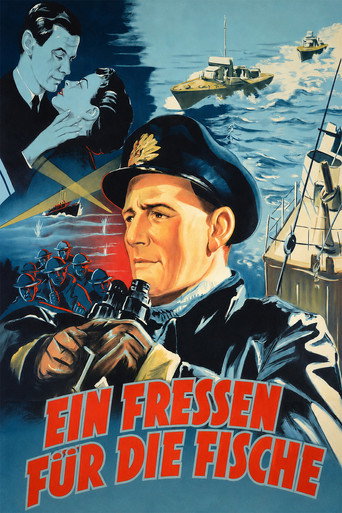
Ein Fressen für die Fische (1952)
Gift Horse
Der Zerstörer "S.M. Ballantrae" ist das Gespött der britischen Marine. Der Kapitän der nachlässigen Besatzung, Hugh Fraser (Trevor Howard), landet beinahe vor dem Kriegsgericht. Als sich die Crew bei einem neuen Einsatz bewährt, bekommt die "Ballantrae" einen gefährlichen Auftrag.
- Erscheinungsdatum
- 1952-06-01
- TMDB
- 6.6 / 10 (23)
- Laufzeit
- 1 Std. 35 Min.
- Genres
- Abenteuer, Kriegsfilm, Drama
- Regie
- Compton Bennett
Besetzung
- Richard Attenborough — Dripper Daniels
- James Donald — Lt. Richard Jennings, No. 1
- Sonny Tufts — Yank Flanagan
- Trevor Howard — Lt. Cmdr Hugh Alginon Fraser
- Bernard Lee — A.S. 'Stripey' Wood
- Dora Bryan — Glad Flanagan
- Hugh Williams — Captain David G. Wilson
- Robin Bailey — Lt. Michael Grant, Pilot
- Meredith Edwards — Jones
- John Forrest — Appleby the Captain's Steward
- Patric Doonan — Petty Officer Martin
- Sidney James — Ned Hardy, Landlord Golden Bull
Wissenswertes
Gift Horse is a 1952 British black-and-white World War II drama film directed by Compton Bennett, and starrimg Trevor Howard, Richard Attenborough, James Donald, and Sonny Tufts. It was written by William Fairchild, Hugh Hastings and William Rose, and was produced by George Pitcher. The film follows the story of the fictional ship HMS Ballantrae and her crew from the time they come together in 1940 until they go on a one-way mission to destroy a German-held dry dock in France. The final mission is based on HMS Campbeltown and the St Nazaire Raid. The title is a reference to the proverb "Never look a gift horse in the mouth".
Production
The movie was meant to star Robert Stack but when he arrived in the UK he was refused a work permit and was replaced by James Donald. Part of the finance came from two rubber merchants, Colonels Weil and Prior.
The film was backed by James Lawrie and John Woolf. They formed a new company, Molton Films, to take the film over from Jay Lewis Productions as Jay Lewis refused to allow director Compton Bennett to work unhindered while filming.
The real-life ship used in the film was HMS Leamington. Built in 1919 as the USS Twiggs, a Wickes-class destroyer, she was one of the last post-war survivors of the 50 elderly four-funnelled destroyers provided in 1940 by the US as part of the "Destroyers for Bases Agreement": (also known as "The Fifty Ships that Saved the World"). She served on convoy duties, including as an escort for the ill-fated Convoy PQ 17.
The film was shot at Isleworth Studios in London with sets designed by the art director Edward Carrick.
Auf Wikipedia weiterlesen · Text aus Wikipedia, CC BY-SA 4.0. Daten aus Wikidata.
Empfohlen
- Kesselschlacht 1949 · ★ 6.7
- Im Wendekreis des Kreuzes 1983 · ★ 7.1
- Die Kanonen von Navarone 1961 · ★ 7.3
- Der letzte Angriff 1951 · ★ 6.5
- Cave Rescue 2019 · ★ 6.0
- Im Banne der roten Hexe 1948 · ★ 5.9
- Spionage in Fernost 1945 · ★ 5.9
- Der Marshal 1969 · ★ 7.3
- Taking Sides - Der Fall Furtwängler 2002 · ★ 6.3
- Hornblower - Froschfresser und Rotröcke 1999 · ★ 7.2
- Fahrkarte nach Marseille 1944 · ★ 6.7
- Katanga 1968 · ★ 6.6