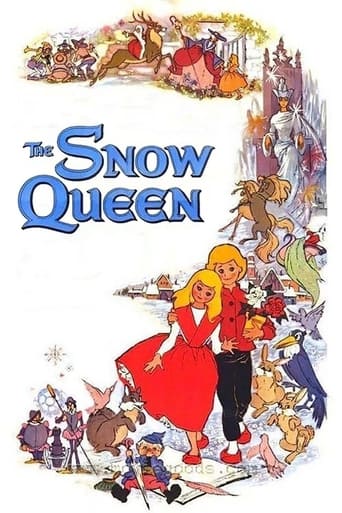
The Snow Queen (1957)
Снежная королева
Miracle, magical, musical entertainment for all ages of the heart!!!
When the Snow Queen, a lonely and powerful fairy, kidnaps the human boy Kai, his best friend Gerda must overcome many obstacles on her journey to rescue him.
- Date of release
- 1957-10-22
- TMDB
- 6.8 / 10 (116)
- Runtime
- 1h 1m
- Genres
- Animation, Family, Fantasy
- Director
- Lev Atamanov
Casting
- Vladimir Gribkov — Ole Lukoje (voice)
- Yanina Zheymo — Gerda (voice)
- Anna Komolova — Kay (voice)
- Mariya Babanova — Snow Queen (voice)
- Galina Kozhakina — Little Robber (voice)
- Sergei Martinson — Karraks (voice)
- Aleksey Konsovskiy — Deer (voice)
- Irina Murzayeva — Old Fairy (voice)
- Vera Popova — Grandmother (voice)
- Elena Ponsova — Crow (voice)
- Vera Bendina — Prince (voice)
- Tatyana Linnik — Princess (voice)
Interesting facts
- Based on: The Snow Queen and Hans Christian Andersen
- Awards: 1 · Nominations: 0
The Snow Queen is a 1957 Soviet animated musical fantasy film directed by Lev Atamanov. It is the ninth full-length animated production by Soyuzmultfilm and is based on the 1844 fable "The Snow Queen" by Hans Christian Andersen. The film is one of the earliest cinematic adaptations of the Scandinavian Danish fable since its publication in New Fairy Tales. First Volume. Second Collection.
Development
Prominent Soviet artists took part in the creation of The Snow Queen film that used traditional hand-drawn animation. The makers of The Scarlet Flower, Golden Antelope (1954 Film) and Dog and Cat (1955 Film) joined to create the various settings such as the Northern German town, the Royal castle, the robber's cave and the snowy expanses of the Queen's domain into one united fairy tale film.
Animators Alexander Vinokurov (ru) created the world of The Snow Queen, Leonid Shvartsman created the characters, while Fyodor Khitruk brought to life two characters – Ole Lukøje and the Snow Queen. The team was held in place by the direction of Lev Atamanov. Fyodor Khitruk later recalled bringing to life the character Ole Lukoye, as one of the most significant characters of the two hundred characters he animated over his many years of practice.
According to the memoirs of Leonid Shvartsman the animators found new hope for the animation industry after the Khruschev Thaw era began. Initially, they thought of drawing inspiration by going to Copenhagen in Denmark, the land where Andersen wrote New Fairy Tales. First Volume. Second Collection (1844). However the route to Western Europe and the Danish lands was closed in the mid-1950s due to the iron curtain.
Read on Wikipedia · Text from Wikipedia, CC BY-SA 4.0. Data from Wikidata.
Recommended
- The Snow Queen 2012 · ★ 5.8
- The Snow Queen 2: Refreeze 2014 · ★ 6.2
- The Snow Queen 3: Fire and Ice 2016 · ★ 7.0
- The Snow Queen: Mirror Lands 2018 · ★ 7.6
- Snow Queen 2002 · ★ 6.1
- Frozen 2013 · ★ 7.2
- A Tooth Fairy Tale 2025 · ★ 8.5
- Secret of the Wings 2012 · ★ 7.3
- Happily Ever After 1989 · ★ 5.8
- Rudolph and Frosty's Christmas in July 1979 · ★ 6.4
- Bedknobs and Broomsticks 1971 · ★ 7.0
- The House of Magic 2013 · ★ 6.3