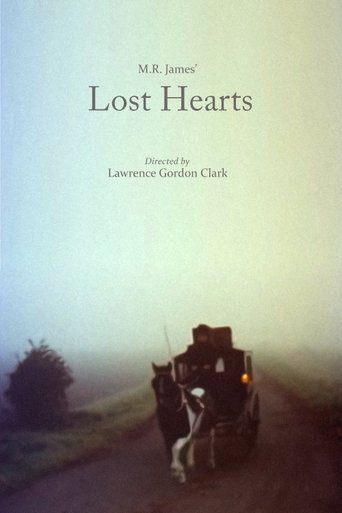
Lost Hearts (1973)
A young orphan, Stephen, is sent to go and live with his strange, much older cousin at his remote country house. Once there, Stephen experiences terrible dreams in which he sees a young girl and boy who are missing their hearts.
- Date of release
- 1973-12-25
- TMDB
- 6.1 / 10 (26)
- Runtime
- 35m
- Genres
- Horror, Mystery, TV Movie
- Director
- Lawrence Gordon Clark
Casting
- Simon Gipps-Kent — Stephen
- Joseph O'Conor — Mr. Abney (as Joseph O'Connor)
- James Mellor — Parkes
- Susan Richards — Mrs. Bunch
- Christopher Davis — Boy
- Michelle Foster — Girl
- Roger Milner — Vicar
Interesting facts
- Based on: Lost Hearts
Lost Hearts is a short film, the third of the British supernatural anthology series A Ghost Story for Christmas. Written by Robin Chapman, produced by Rosemary Hill, and directed by the series' creator, Lawrence Gordon Clark, it is based on the 1895 ghost story of the same name by M. R. James and first aired on BBC1 on 25 December 1973. It is the first instalment to have been broadcast on Christmas Day itself, and one of only three in the series' history.
Production
Grade II* listed Ormsby Hall in South Ormsby in Lincolnshire stood in for the exterior shots of Aswarby Hall, while the churchyard of the nearby St Leonard's church in the village featured in the final scenes including the ghostly children waving to Stephen.
Harrington Hall in Harrington, Lincolnshire was used for the interior of Aswarby Hall, as well as a few outside scenes. The interiors seen in the film were all destroyed by a fire which occurred in 1991.
The Pelham Mausoleum near Brocklesby in Great Limber near Grimsby also featured in the production.
Most music from the film is taken from Hyperion III, a 1966 avant-garde piece by Bruno Maderna. The 25-minute recording was performed by the Southwest German Radio Symphony Orchestra, Baden Baden, with Severino Gazzelloni on the flute. Also featured is My Bonny Boy from Ralph Vaughan Williams English Folk Song Suite, performed by the London Symphony Orchestra, conducted by Sir Adrian Boult.
The adaptation is noted for the distinctive hurdy-gurdy music that accompanies appearances of the two ghostly children. This has been wrongly identified as L'amour de Moi, a 15th Century French folk song, but BBC copyright documentation confirms that this title is instead the tune hummed briefly by Joseph O'Conor.
Read on Wikipedia · Text from Wikipedia, CC BY-SA 4.0. Data from Wikidata.
Recommended
- The Woman in Black 1989 · ★ 6.9
- Aurora Teagarden Mysteries: How to Con A Con 2021 · ★ 7.2
- American Horror House 2012 · ★ 5.9
- The Night Stalker 1972 · ★ 6.9
- The Haunted 1991 · ★ 5.9
- The Hound of the Baskervilles 1983 · ★ 6.5
- Basilisk: The Serpent King 2006 · ★ 6.2
- Come Play 2020 · ★ 6.4
- Megaboa 2021 · ★ 6.3
- Aurora Teagarden Mysteries: Heist and Seek 2020 · ★ 7.4
- Aurora Teagarden Mysteries: Til Death Do Us Part 2021 · ★ 7.4
- Mystery 101 2019 · ★ 7.2