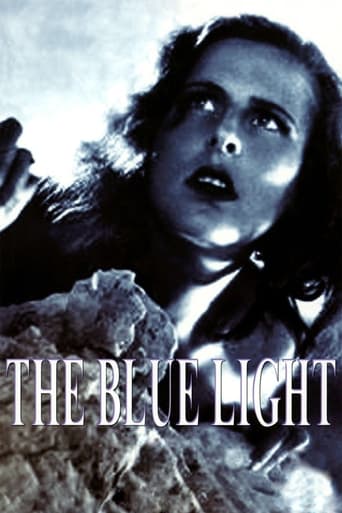
The Blue Light (1932)
Das blaue Licht
A mountain legend from the Dolomites
Junta is hated by the people in the village where she lives, especially by the women, who suspect her of being a witch. Only she can climb the nearby mountains to a cave high up, whence a mysterious blue light glows when the moon is full. Many young men of the village have died trying to follow her. She is driven out of town, and takes to living in the mountains. Eventually she shares the secret of the blue light with one man, and he betrays it.
- Date of release
- 1932-03-24
- TMDB
- 6.9 / 10 (34)
- Runtime
- 1h 23m
- Genres
- Drama, Adventure, Fantasy, Mystery
- Director
- Leni Riefenstahl
Casting
- Leni Riefenstahl — Junta
- Mathias Wieman — Vigo
- Beni Führer — Tonio
- Max Holzboer — Innkeeper
- Martha Mair — Lucia
- Franz Maldacea — Guzzi
Interesting facts
The Blue Light is a black-and-white 1932 film directed by Leni Riefenstahl and written by Béla Balázs with uncredited scripting by Carl Mayer. In Riefenstahl's film version, the witch, Junta, played by Riefenstahl, is intended to be a sympathetic character. Filming took place in the Brenta Dolomites, in Ticino, Switzerland, and Sarntal, South Tirol.
Production
Leni Riefenstahl's directorial debut, The Blue Light was written by Béla Balázs. However, as Balázs was Jewish, Riefenstahl was credited as the writer in re-releases following Hitler's ascent to power.
In the documentary The Wonderful, Horrible Life of Leni Riefenstahl (1993), Riefenstahl relates that the Agfa Film Corporation gave her a new film stock called R-Stock. When filming was done through a red filter the sky would appear absolutely black, achieving day-for-night. The film was among the first sound films to be filmed entirely on location.
Arnold Fanck, who had directed several mountain films featuring Riefenstahl, did a first edit of the film, which Riefenstahl found unacceptable, and she completely re-edited the film. While the original edit needed work, Riefenstahl's production of the film was ahead of her time.
A similarly named legend in Germany (Das blaue Licht) may have lent some inspiration to the screenplay. During a time when a pan-Germanic ethos was sweeping the country, audiences were highly likely to have been familiar with the old legend, and accordingly expected the film to follow it closely.
The original legend, compiled by the Brothers Grimm in 1810, and later popularized by the German nationalists of the 1920s, tells the story of a crippled soldier who is terminated from the service of his king. Released from service, he travels into the woods to seek a cure, and comes upon a witch's house. It is there that he asks her if she is willing to help him. She agrees to cure him but he must first do three things for her.
Read on Wikipedia · Text from Wikipedia, CC BY-SA 4.0. Data from Wikidata.
Recommended
- Everest 2015 · ★ 6.8
- Seven Years in Tibet 1997 · ★ 7.2
- The Secret Life of Bees 2008 · ★ 7.5
- The Caveman's Valentine 2001 · ★ 5.9
- Until the End of the World 1991 · ★ 6.7
- The Universal Theory 2023 · ★ 5.9
- The Physician II 2025 · ★ 6.6
- The Red House 1947 · ★ 6.3
- True Grit 1969 · ★ 7.3
- Cave Rescue 2019 · ★ 5.9
- The Eternal Daughter 2022 · ★ 5.9
- Remember 2015 · ★ 7.3