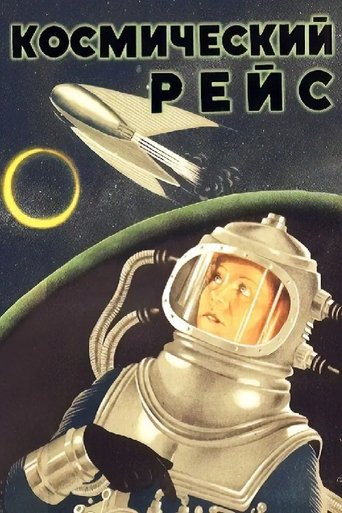
宇宙旅行记 (1936)
Космический рейс
Scientist Pavel Sedykh grows impatient with the restrictions of the conservative Soviet space institute in Moscow. Sedikh builds his own spacecraft, and accompanied by a female astronaut and a boy, he embarks on a the first human trip to the moon.
- 上映日期
- 1936-01-21
- TMDB
- 6.4 / 10 (23)
- 片长(分钟)
- 1小时10分钟
- 类型
- 科幻
- 导演
- Василий Журавлёв
演员阵容
- Сергей Комаров — Pavel Ivanovich Sedykh, academician
- Ксения Москаленко — Prof. Marina
- Виктор Гапоненко — Andryusha Orlov, a boy
- Николай Феоктистов — Capt. Viktor Orlov
- Василий Ковригин — Prof. Karin
- 谢尔盖·斯托里亚罗夫 — Take-off technician
- Любовь Ненашева — Mother of Orlovs
- Владимир Константинов — Pioneer (uncredited)
趣闻
Cosmic Voyage or The Space Voyage is a 1936 Soviet science fiction silent film directed by Vasili Zhuravlov and produced by Mosfilm. It was one of the earliest films to represent a realistic spaceflight, including weightlessness as well as one of the last Soviet silent era films.
Production
Kosmicheskiy reys: Fantasticheskaya novella was initially conceived in 1924 by Russian filmmaker Vasili Zhuravlov, but it was not pursued for production until 1932, when Komsomol (the Communist Union of Youth) recommended the creation of film that would spur an interest in space studies. Zhuravlov consulted with Konstantin Tsiolkovsky, the noted aeronautical theorist and rocket science engineer, on the screenplay.
Two spaceships in the film were named after the Soviet leaders Joseph Stalin and Kliment Voroshilov. The film's cosmonauts enter liquid-filled chambers to buffer the impact of takeoff and landing, and they communicate their landing to the Earth by spelling out "CCCP" (the Russian-language acronym for "USSR") with reflective substances spread across the lunar surface.
Kosmicheskiy reys: Fantasticheskaya novella was shot as a silent film and had only a brief release in early 1936 before being removed from circulation by Soviet censors, who felt that stop-motion animated sequences of cosmonauts hopping across the low-gravity lunar surface were antithetical to the spirit of "socialist realism." It was not widely seen again until the 1980s.
在维基百科阅读更多 · 文本来自维基百科,CC BY-SA 4.0。数据来自 Wikidata。