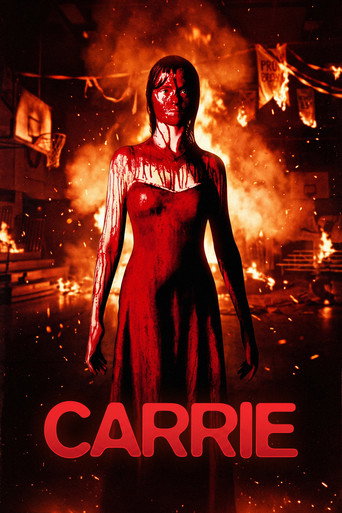
Carrie (2002)
If only they knew she had the power.
An awkward, telekinetic teenage girl's lonely life is dominated by relentless bullying at school and an oppressive religious fanatic mother at home. When her tormentors pull a humiliating prank at the senior prom, she unleashes a horrifying chaos on everyone, leaving nothing but destruction in her wake.
- Date of release
- 2002-11-04
- TMDB
- 6.1 / 10 (608)
- Runtime
- 2h 12m
- Genres
- Horror, TV Movie, Thriller
- Director
- David Carson
Casting
- Angela Bettis — Carrie White
- Patricia Clarkson — Margaret White
- Rena Sofer — Miss Desjarden
- Kandyse McClure — Sue Snell
- Emilie de Ravin — Christine Hargenson
- Tobias Mehler — Tommy Ross
- Jesse Cadotte — Billy Nolan
- Meghan Black — Norma Watson
- Chelan Simmons — Helen Shyres
- Katharine Isabelle — Tina Blake
- David Keith — Det. John Mulchaey
- Miles Meadows — Kenny Garson
Interesting facts
- Based on: Carrie
Carrie is a 2002 supernatural horror television film based on the 1974 novel by Stephen King. As the second film adaptation and third film in the Carrie franchise, it sticks closely to the original story. The film was written by Bryan Fuller, directed by David Carson, and stars Angela Bettis in the leading role. In the story, Carrie White, a shy girl who was harassed by her schoolmates, is declared dead after a horrific event at her high school, and a series of flashbacks reveal what has happened to her.
Production
In May 2002, television network NBC commissioned a film adaptation of Stephen King's novel Carrie. Filming started the following month in Vancouver, British Columbia, Canada, on June 12, and took at least twenty days. King had no involvement in this version after another film adaptation, The Rage: Carrie 2 (1999), disappointed him. It was produced by MGM Television and Trilogy Entertainment Group based on a teleplay by Bryan Fuller.
The network originally wanted a "movie-of-the-week", but the studio wanted to capitalize on the production so it was planned as a backdoor pilot for a potential television series. Although the producers tried to be faithful to King's novel, in order to allow for a continuation of the story, the ending was changed so that Carrie White remained alive.
Envisaged as a remake of Brian De Palma's 1976 film, Fuller aimed to "give it [...] a little more of an epic feel" rather than the fairy tale-feeling Fuller ascribed to the original. He also thought his version could add "a little more depth" with "some scope to the characters and the situation", which was not present in the original.
[Carrie] is not a murderer, and, especially the way Angela portrays her, she is a sympathetic, sweet soul who is a bit more edgy than Sissy Spacek's Carrie. Sissy portrayed her as—I don't want to say pathetic, but just really as a victim. Angela give[s] the character such a strong core, and we felt that we couldn't turn this character who was so sweet into a murderer and then kill her. We wanted to give her another chance.
Fuller sought to update the film's 1970s setting to a contemporary one, aware that high-school violence, in particular, has changed since then. Because Fuller felt the Columbine High School massacre was still on people's recent memory, he was careful in addressing the film's "teenage vigilante" theme.
Read on Wikipedia · Text from Wikipedia, CC BY-SA 4.0. Data from Wikidata.
Recommended
- Carrie 1976 · ★ 7.3
- The Final 2010 · ★ 6.0
- Goodnight Mommy 2022 · ★ 6.3
- Hello Mary Lou: Prom Night II 1987 · ★ 6.0
- The Bad Seed Returns 2022 · ★ 7.0
- The Long Walk 2025 · ★ 6.8
- Look Away 2018 · ★ 6.5
- Stalked by My Doctor 2015 · ★ 6.0
- Black Box 2026 · ★ 5.9
- The Devil Conspiracy 2023 · ★ 6.4
- The Bad Seed 2018 · ★ 7.1
- Girl in the Basement 2021 · ★ 7.6