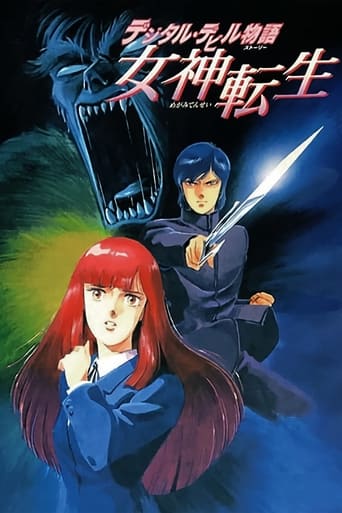
Digital Devil Story - Megami Tensei (1987)
デジタル・デビル物語 女神転生
Der gutaussehende High School Student Akemi ist ein Computergenie. Eines Tages kommt ein neues Mädchen namens Yumiko in seine Klasse. Sie verliebt sich schnell in Akemi, aber dieser ist so vertieft in seinen Computer, dass er Yumiko keinerlei Beachtung schenkt. Der Grund dafür ist ein Monster, das er mit seinem Computer geschaffen hat. Digital Devil wurde zu seinem eigenen bösen Geist, den Akemi nach der Schule ruft, sodass dieser Rache an seinen Feinden nimmt.
- Erscheinungsdatum
- 1987-03-25
- TMDB
- 5.9 / 10 (15)
- Laufzeit
- 45 Min.
- Genres
- Animation, Science Fiction, Horror
- Regie
- 西久保瑞穂
- Filmreihe
- 女神転生シリーズ
Besetzung
- 水島裕 — Akemi Nakajima (voice)
- Saeko Shimazu — Yumiko Shirasagi (voice)
- Masako Katsuki — Izanami (voice)
- Hochu Otsuka — Loki (voice)
- Masaharu Satō — Hiroyuki Kondou (voice)
- Fumihiko Tachiki — Susumu Takai (voice)
- 横尾まり — Ohara (voice)
- Megumi Hayashibara — Kanou Fuyuki (voice)
- カシワクラツトム — Student (voice)
- 山形ユキオ — Kaneto Muraki (voice)
- Yuuri Sugimoto — Kyoko Takamizawa (voice)
- 喜多川拓郎 — Teacher Iida (voice)
Wissenswertes
- Basiert auf: Digital Devil Story
Digital Devil Story: Megami Tensei refers to two distinct role-playing video games based on the Digital Devil Story trilogy of science fiction novels by Japanese author Aya Nishitani. One version was developed by Atlus and published by Namco in 1987 for the Famicom—Atlus would go on to create further games in the Megami Tensei franchise. A separate version for personal computers was developed and published by Telenet Japan with assistance from Atlus during the same year.
Development
Digital Devil Story: Megami Tensei was adapted from Digital Devil Story, a trilogy of science fiction books written by Japanese author Aya Nishitani. Published by Tokuma Shoten, the novels were a major success in Japan. Nishitani and Tokuma Shoten began working to adapt the books into a multimedia series, beginning with an original video animation (OVA), which retold the events of the first novel, and creating a tie-in video game during the OVA's…
The Atlus version was directed by Kouji Okada, while the scenario's original elements were written by Kazunari Suzuki. Sprite and promotional artwork was designed by Esaki Minoru, and the music was composed by Tsukasa Masuko. During the early phases, the gameplay concept was a near-copy of the gameplay style of the Wizardry series, attributed by Suzuki to their superiors being fans of the series.
Nishitani was deeply involved in planning the game, contributing suggestions and advice for the project. According to Okada, a major issue during development was faithfully following the novel's plot due to the limited hardware space on the Famicom cartridge, together with the necessity of creating a compelling gameplay experience.
Auf Wikipedia weiterlesen · Text aus Wikipedia, CC BY-SA 4.0. Daten aus Wikidata.
Empfohlen
- Urotsukidoji 3: Return of the Overfiend 1993 · ★ 6.6
- Bleach: Memories of Nobody 2006 · ★ 6.9
- Cat Soup 2001 · ★ 7.1
- Die Monster Academy 2020 · ★ 6.0
- X - The Movie 1996 · ★ 6.2
- The Garden of Sinners: Recalled Out Summer 2013 · ★ 7.3
- Books of Blood 2020 · ★ 6.2
- Doraemon: Nobita's Dorabian Nights 1991 · ★ 7.0
- Demon City Shinjuku 1988 · ★ 6.0
- Memories 1995 · ★ 7.5
- Doraemon: Nobita's Little Star Wars 1985 · ★ 7.2
- Gantz - Spiel um dein Leben 2010 · ★ 6.5