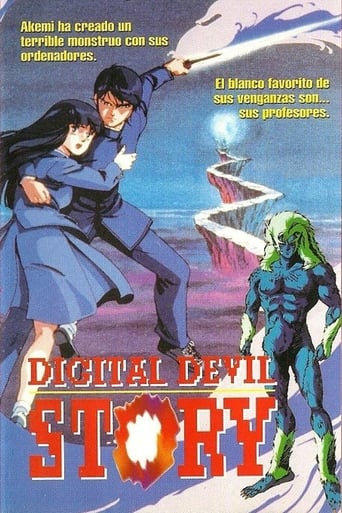
Digital Devil Story (1987)
デジタル・デビル物語 女神転生
Akemi ha creado un terrible montruo con sus ordenadores. Su blanco favorito de sus venganzas son... Sus profesores.
- Fecha de estreno
- 1987-03-25
- TMDB
- 5.9 / 10 (15)
- Duración
- 45 min
- Géneros
- Animación, Ciencia ficción, Terror
- Director
- 西久保瑞穂
- Colección
- Megami Tensei Collection
Reparto
- Yu Mizushima — Akemi Nakajima (voice)
- 島津冴子 — Yumiko Shirasagi (voice)
- Masako Katsuki — Izanami (voice)
- Hochu Otsuka — Loki (voice)
- Masaharu Satō — Hiroyuki Kondou (voice)
- Fumihiko Tachiki — Susumu Takai (voice)
- Mari Yokoo — Ohara (voice)
- Megumi Hayashibara — Kanou Fuyuki (voice)
- カシワクラツトム — Student (voice)
- 山形ユキオ — Kaneto Muraki (voice)
- Yuuri Sugimoto — Kyoko Takamizawa (voice)
- 喜多川拓郎 — Teacher Iida (voice)
Curiosidades
- Basada en: Digital Devil Story
Digital Devil Story: Megami Tensei refers to two distinct role-playing video games based on the Digital Devil Story trilogy of science fiction novels by Japanese author Aya Nishitani. One version was developed by Atlus and published by Namco in 1987 for the Famicom—Atlus would go on to create further games in the Megami Tensei franchise. A separate version for personal computers was developed and published by Telenet Japan with assistance from Atlus during the same year.
Development
Digital Devil Story: Megami Tensei was adapted from Digital Devil Story, a trilogy of science fiction books written by Japanese author Aya Nishitani. Published by Tokuma Shoten, the novels were a major success in Japan. Nishitani and Tokuma Shoten began working to adapt the books into a multimedia series, beginning with an original video animation (OVA), which retold the events of the first novel, and creating a tie-in video game during the OVA's…
The Atlus version was directed by Kouji Okada, while the scenario's original elements were written by Kazunari Suzuki. Sprite and promotional artwork was designed by Esaki Minoru, and the music was composed by Tsukasa Masuko. During the early phases, the gameplay concept was a near-copy of the gameplay style of the Wizardry series, attributed by Suzuki to their superiors being fans of the series.
Nishitani was deeply involved in planning the game, contributing suggestions and advice for the project. According to Okada, a major issue during development was faithfully following the novel's plot due to the limited hardware space on the Famicom cartridge, together with the necessity of creating a compelling gameplay experience.
Leer en Wikipedia · Texto de Wikipedia, CC BY-SA 4.0. Datos de Wikidata.
Recomendadas
- Bleach: Memories of Nobody 2006 · ★ 6.9
- Urotsukidoji III: El retorno del Señor del mal 1993 · ★ 6.6
- Academia Cranston: Escuela de Monstruos 2020 · ★ 6.0
- X: La película 1996 · ★ 6.2
- Libros de sangre 2020 · ★ 6.2
- Doraemon y las mil y una aventuras 1991 · ★ 7.0
- Sopa de Gato 2001 · ★ 7.1
- El Jardín de los Pecadores: Evangelio Futuro 2013 · ★ 7.3
- Memories 1995 · ★ 7.5
- Gantz: Génesis (Gantz: Parte 1) 2010 · ★ 6.5
- Devilman Volumen 2: El pájaro del demonio 1990 · ★ 6.9
- Demon City Shinjuku 1988 · ★ 6.0