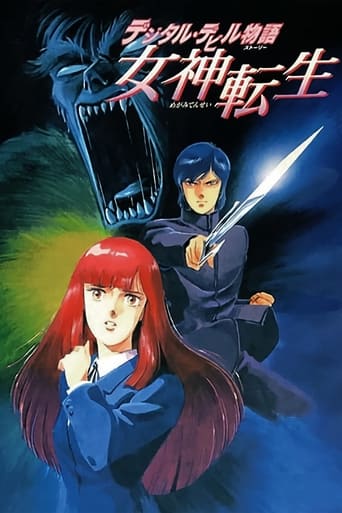
デジタル・デビル物語 女神転生 (1987)
Handsome high school student Akemi is a computer genius. One day a new girl, Yumiko, transfers to his class from another school. She quickly falls in love with Akemi but, absorbed in his computer, he pays her no attention at all. Akemi accidentally summons demons who wreak chaos on his enemies and friends.
- Data de estreia
- 1987-03-25
- TMDB
- 5.9 / 10 (15)
- Duração
- 45 min
- Géneros
- Animação, Ficção científica, Terror
- Realizador
- 西久保瑞穂
- Coleção
- 女神転生シリーズ
Elenco
- 水島裕 — Akemi Nakajima (voice)
- 島津冴子 — Yumiko Shirasagi (voice)
- Masako Katsuki — Izanami (voice)
- 大塚芳忠 — Loki (voice)
- Masaharu Satō — Hiroyuki Kondou (voice)
- 立木文彦 — Susumu Takai (voice)
- 横尾まり — Ohara (voice)
- 林原めぐみ — Kanou Fuyuki (voice)
- カシワクラツトム — Student (voice)
- 山形ユキオ — Kaneto Muraki (voice)
- Yuuri Sugimoto — Kyoko Takamizawa (voice)
- 喜多川拓郎 — Teacher Iida (voice)
Curiosidades
- Baseado em: Digital Devil Story
Digital Devil Story: Megami Tensei refers to two distinct role-playing video games based on the Digital Devil Story trilogy of science fiction novels by Japanese author Aya Nishitani. One version was developed by Atlus and published by Namco in 1987 for the Famicom—Atlus would go on to create further games in the Megami Tensei franchise. A separate version for personal computers was developed and published by Telenet Japan with assistance from Atlus during the same year.
Development
Digital Devil Story: Megami Tensei was adapted from Digital Devil Story, a trilogy of science fiction books written by Japanese author Aya Nishitani. Published by Tokuma Shoten, the novels were a major success in Japan. Nishitani and Tokuma Shoten began working to adapt the books into a multimedia series, beginning with an original video animation (OVA), which retold the events of the first novel, and creating a tie-in video game during the OVA's…
The Atlus version was directed by Kouji Okada, while the scenario's original elements were written by Kazunari Suzuki. Sprite and promotional artwork was designed by Esaki Minoru, and the music was composed by Tsukasa Masuko. During the early phases, the gameplay concept was a near-copy of the gameplay style of the Wizardry series, attributed by Suzuki to their superiors being fans of the series.
Nishitani was deeply involved in planning the game, contributing suggestions and advice for the project. According to Okada, a major issue during development was faithfully following the novel's plot due to the limited hardware space on the Famicom cartridge, together with the necessity of creating a compelling gameplay experience.
Ler na Wikipédia · Texto da Wikipédia, CC BY-SA 4.0. Dados do Wikidata.
Recomendados
- Gekijouban Bleach - Memories of Nobody 2006 · ★ 6.9
- Urotsukidōji III: O Regresso do Demônio 1993 · ★ 6.6
- Academia Cranston - Cenas Monstruosas! 2020 · ★ 6.0
- X 1996 · ★ 6.2
- Livros de Sangue 2020 · ★ 6.2
- Doraemon e as Mil e Uma Aventuras 1991 · ★ 7.0
- Sopa de Gato 2001 · ★ 7.1
- Gekijouban Kara no Kyoukai - Mirai Fukuin - The Garden of Sinners Recalled Out Summer 2013 · ★ 7.3
- Memories 1995 · ★ 7.5
- Gantz 2010 · ★ 6.5
- Devil Man - Demon Bird 1990 · ★ 6.9
- Shinjuku Cidade Demoníaca 1988 · ★ 6.0