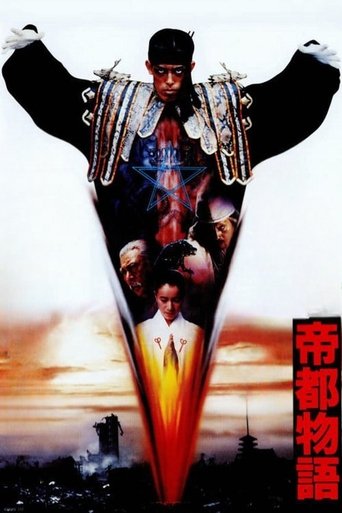
帝都物語 (1988)
A demonic reincarnation of a Japanese general from the 10th century appears in the early 20th century Tokyo with a mission to destroy the blooming city.
- Data lansării
- 1988-01-30
- TMDB
- 6.1 / 10 (24)
- Durată
- 2 h 15 min
- Genuri
- Fantasy, Horror, Thriller
- Regizor
- 実相寺昭雄
- Colecție
- 帝都物語
Distribuție
- 勝新太郎 — Eichi Shibusawa
- 嶋田久作 — Yasunori Kato
- 原田美枝子 — Keiko Tatsumiya
- 石田純一 — Yoichiro Tatsumiya
- 五代目 坂東玉三郎 — Kyoka Izumi
- 姿晴香 — Yukari Tatsumiya
- Bunshi Katsura Vi — Shigemaru Kuroda
- 佐野史郎 — Junichi Narumi
- 平幹二朗 — Yasumasa Hirai
- 高橋幸治 — Rohan Koda
- 西村晃 — Makoto Nishimura
- 大滝秀治 — Masayuki Orida
Curiozități
Tokyo: The Last Megalopolis is a 1988 Japanese epic tokusatsu historical dark fantasy/science fiction film directed by Akio Jissoji, produced by "Exe" studios and distributed by Toho Studios. It is the first cinematic adaptation of the award-winning historical fantasy novel Teito Monogatari by Hiroshi Aramata. The film stars Kyūsaku Shimada, Shintaro Katsu, Kōji Takahashi, Jo Shishido, Junichi Ishida, Mieko Harada, Kō Nishimura, and Shirō Sano among others. With a budget of around 1 billion yen, the movie was one of the most expensive live action Japanese special effects films to have been produced during that decade.
Production
When producer Takashige Ichise finished The Legend of the Stardust Brothers in 1984, the Saison Group provided funding, which led to Ichise becoming an employee of Seibu Department Store. From there, he transitioned to the movie studio EXE. A colleague at the studio suggested to him the idea of producing Teito Monogatari for their next motion picture. Ichise went on to recruit director Akio Jissoji for the project.
At the time, the Seibu Department Store was holding an exhibition for the works of Swiss artist H. R. Giger. Giger was visiting Japan at the time, and Ichise personally asked to provide designs for the film's creatures, to which he agreed. Originally, he showed interest in working directly on set, however his schedule would not permit it. His main contribution was the conceptual art for the gohō dōji.
Ichise alongside Koji Tsutsumi (the son of Seiji Ttutsumi), pitched the idea to Toho Studios to distribute the picture. According to reports, the proposal was laughed at by Toho executives, who didn't think the film was practical.
The script was originally written by screenwriter Kishida Rio, who was recommended by Akio Jissoji. However Ichise did not think Rio's script was entertaining enough. Instead Ichise recruited screenwriter Kaizo Hayashi to write the script. The two stayed at the Wakaba Inn in Kagurazuka and worked on the script together. Hayashi was asked to make a "picture scroll-like film with a star studded cast".
Many staff members who worked on the Ultraman television series were involved in the production, including director Akio Jissoji, cinematographer Masao Nakahori, and special effects director Minoru Nakano. Minoru Nakano reportedly stated that he saw Tokyo: The Last Megalopolis as representing an evolution in traditional Eiji Tsuburaya tokusatsu special effects.
Citește pe Wikipedia · Text din Wikipedia, CC BY-SA 4.0. Date din Wikidata.
Recomandate
- Nightbreed 1990 · ★ 6.4
- The Unhealer 2021 · ★ 5.8
- Samurai Reincarnation 1981 · ★ 5.8
- Wrath of Daimajin 1966 · ★ 6.3
- Dororo 2007 · ★ 7.0
- Demon City Shinjuku 1988 · ★ 6.0
- Blestemul 2004 · ★ 5.9
- Nocebo 2022 · ★ 6.0
- Urotsukidōji: Legend of the Overfiend 1989 · ★ 6.0
- Ninja III: The Domination 1984 · ★ 6.2
- Mona Lisa and the Blood Moon 2022 · ★ 6.4
- Din adâncurile apei întunecate 2002 · ★ 6.8