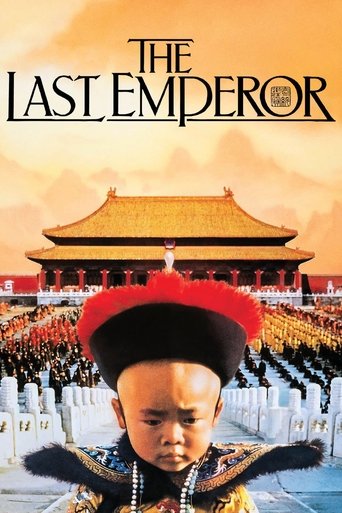
The Last Emperor (1987)
1500 slaves. 353,260,000 royal subjects. Warlords. Concubines. And 2 wives. He was the loneliest boy in the world.
A dramatic history of Pu Yi, the last of the Emperors of China, from his lofty birth and brief reign in the Forbidden City, the object of worship by half a billion people; through his abdication, his decline and dissolute lifestyle; his exploitation by the invading Japanese, and finally to his obscure existence as just another peasant worker in the People's Republic.
- Date of release
- 1987-10-04
- TMDB
- 7.6 / 10 (2039)
- Runtime
- 2h 43m
- Genres
- Drama, History
- Director
- Bernardo Bertolucci
Casting
- John Lone — Pu Yi (Adult)
- Joan Chen — Wan Jung
- Peter O'Toole — Reginald Johnston (R.J.)
- Ruocheng Ying — The Governor
- Victor Wong — Chen Pao Shen
- Dennis Dun — Big Li
- Ryuichi Sakamoto — Amakasu
- Maggie Han — Eastern Jewel
- Ric Young — Interrogator
- Vivian Wu — Wen Hsiu
- Cary-Hiroyuki Tagawa — Chang
- Jade Go — Ar Mo
Interesting facts
- Box office: $44M
- Budget: $23.8M
- Earned 1.8× its budget
- Based on: The First Half of My Life
- Filmed in: Beijing
- Awards: 13 · Nominations: 10. Including: Academy Award for Best Picture; David di Donatello for Best Film; César Award for Best Foreign Film; Academy Award for Best Director
The Last Emperor is a 1987 epic biographical drama film about the life of Puyi, the last Emperor of China. It is directed by Bernardo Bertolucci from a screenplay he co-wrote with Mark Peploe, which was adapted from Puyi's 1964 autobiography, and independently produced by Jeremy Thomas.
Production
Bernardo Bertolucci proposed the film to the Chinese government as one of two possible projects – the other was an adaptation of La Condition humaine (Man's Fate) by André Malraux. The Chinese preferred The Last Emperor. Producer Jeremy Thomas managed to raise the $25 million budget for his ambitious independent production single-handedly. At one stage, he scoured the phone book for potential financiers.
19,000 extras were needed over the course of the film. The People's Liberation Army (PLA) was drafted in to accommodate.
In a 2010 interview with Bilge Ebiri for Vulture.com, Bertolucci recounted the shooting of the Cultural Revolution scene:
Before shooting the parade scene, I put together four or five young directors whom I had met, [including] Chen Kaige — who also plays a part in the film, he's the captain of the guard — and Zhang Yimou. I asked them about the Cultural Revolution. And suddenly it was like I was watching a psychodrama: they started to act out and cry, it was extraordinary. I think there is a relationship between these scenes in The Last Emperor and in 1900.
Read on Wikipedia · Text from Wikipedia, CC BY-SA 4.0. Data from Wikidata.
Recommended
- Empire of the Sun 1987 · ★ 7.5
- Munich - The Edge of War 2021 · ★ 6.9
- The Way Back 2010 · ★ 7.0
- The Zone of Interest 2023 · ★ 7.0
- The Left Hand of God 1955 · ★ 6.3
- Experimenter 2015 · ★ 6.5
- Victoria & Abdul 2017 · ★ 6.9
- Richard Jewell 2019 · ★ 7.4
- Kundun 1997 · ★ 6.8
- The Lost City of Z 2017 · ★ 6.4
- Taking Sides 2002 · ★ 6.3
- Emperor 2012 · ★ 6.2