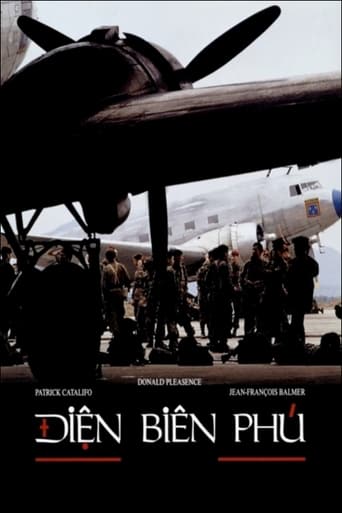
Dien Bien Phu (1992)
Diên Biên Phu
Vietnam, 1954. An American reporter finds himself in the middle of the battle of Điện Biên Phủ, between the French army and the Vietminh.
- Date of release
- 1992-03-04
- TMDB
- 6.5 / 10 (44)
- Runtime
- 2h 5m
- Genres
- Drama, War
- Director
- Pierre Schoendoerffer
Casting
- Donald Pleasence — Howard Simpson
- Patrick Catalifo — Captain Jégu de Kerveguen
- Jean-François Balmer — AFP Employee
- Ludmila Mikaël — Béatrice Vergnes
- François Négret — Corporal
- Maxime Leroux — Artillery Lieutenant
- Raoul Billerey — Father Bambourger
- Thế Anh — Ong Cop, M. Tigre
- Christopher Buchholz — Captain Morvan
- Patrick Chauvel — Lieutenant Duroc, DC3 Pilot
- Eric Do — Lieutenant Ki
- Igor Hossein — Photograph
Interesting facts
- Budget: $27M
Diên Biên Phu is a French 1992 epic war film written and directed by French veteran Pierre Schoendoerffer. With its huge budget, all-star cast, and realistic war scenes produced with the cooperation of both the French and Vietnamese armed forces, Dîen Bîen Phu is regarded by many as one of the more important war movies produced in French filmmaking history. It portrays the 55-day siege of Dien Bien Phu (1954), one of the last battles by the French Union's colonial army in the First Indochina War during the final days of French Indochina, which was soon after divided into North and South Vietnam. This was a prelude to the Second Indochina War, known in the United States as the Vietnam War.
Production
Unlike many Hollywood Vietnam War blockbusters, Dîen Bîen Phu is, according to the director, more a docudrama based on real events, in the style of Tora! Tora! Tora!. Writer/director Pierre Schoendoerffer is a veteran of the battle; in 1952, volunteer Corporal Schoendoerffer joined the Service Cinématographique des Armées (French Army Cinematographic Service) as a cameraman.
On 11 March 1954, Schoendoerffer was injured at Dien Bien Phu, in a minor skirmish (Cote 781 attack) before the main battle, and he was sent to the southern base located in Saigon aboard a C-47 transport plane. Since there were no other cameramen remaining on the battlefield, Schoendoerffer insisted on returning to document the event.
Schoendoerffer was still injured and wore bandages when he chose to return to the battlefield. Officers told him "it's wasted, don't go!" ("c'est foutu, n'y va pas!"), but he insisted as "[he] had to be there to testify" as he planned to give his film to the pilots, after the battle, as an homage.
Schoendoerffer used a Bell & Howell 35mm black-and-white camera with three telephoto lenses mounted on a turret. This model is known for its highly flammable film but also for "its remarkable black and grey picture quality never seen again since" dixit Pierre Schoendoerffer.
On May 7, 1954, at 6 p.m., a half-hour after the French ceasefire (except for the strongpoint Isabelle still fighting until May 8 1:00 a.m.) he was ordered to get out of his Parachute Commandment blockhouse, where he was waiting with the officers Bigeard and Langlais and the military nurse Geneviève de Galard and subsequently became a Viet Minh POW.
Read on Wikipedia · Text from Wikipedia, CC BY-SA 4.0. Data from Wikidata.
Recommended
- We Were Soldiers 2002 · ★ 7.1
- To the Ends of the World 2018 · ★ 6.0
- Danger Close: The Battle of Long Tan 2019 · ★ 6.8
- Jacknife 1989 · ★ 6.4
- Apocalypse Now 1979 · ★ 8.3
- Casualties of War 1989 · ★ 7.2
- Full Metal Jacket 1987 · ★ 8.1
- Missing in Action 1984 · ★ 5.9
- Heaven & Earth 1993 · ★ 6.6
- The Last Full Measure 2020 · ★ 7.3
- Birdy 1984 · ★ 7.1
- Go Tell the Spartans 1978 · ★ 6.2