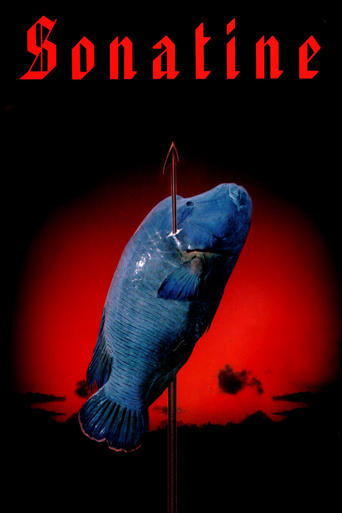
Sonatine (1993)
A ferocious man sleeps here.
Murakawa, an aging Tokyo yakuza tiring of gangster life, is sent by his boss to Okinawa along with a few of his henchmen to help end a gang war, supposedly as mediators between two warring clans. He finds that the dispute between the clans is insignificant and whilst wondering why he was sent to Okinawa at all, his group is attacked in an ambush. The survivors flee and make a decision to lay low at the beach while they await further instructions.
- Date of release
- 1993-09-10
- TMDB
- 7.5 / 10 (724)
- Runtime
- 1h 34m
- Genres
- Action, Crime, Thriller
- Director
- Takeshi Kitano
Casting
- Takeshi Kitano — Aniki Murakawa
- Aya Kokumai — Miyuki
- Tetsu Watanabe — Uechi
- Masanobu Katsumura — Ryoji
- Susumu Terajima — Ken
- Ren Osugi — Katagiri
- Tonbo Zushi — Kitajima
- Kenichi Yajima — Takahashi
- Eiji Minakata — The Hit Man
- Houka Kinoshita — Kitajima Gang Member
- Rome Kanda — Rapist
- Kota Mizumori — Kanamoto
Interesting facts
- Box office: $58.8K
Sonatine is a 1993 Japanese yakuza film directed, written and edited by Takeshi Kitano, who also stars in the film. It won numerous awards and became one of Kitano's most successful and praised films, garnering him a sizable international fan base.
Production
The film was conceived with four basic scenes; yakuza having to go to Okinawa, yakuza arriving in Okinawa, the machine-gun shootout, and the main character shooting himself in the head. Kitano said his shooting technique is spontaneous in that he allowed the film to fill in the space between these four scenes itself.
The title Sonatine comes from the musical term sonatina. Kitano said that when learning the piano, when the learner gets to sonatinas they have to decide where they want to go, whether it is to classical, jazz or popular music; marking the point of crucial decision making. This refers to the character Murakawa in the film. The film's original title, "Okinawa Pierrot", was a possible reference to Jean-Luc Godard's Pierrot le fou.
The film's poster is of a Napoleon fish being pierced with a spear. Kitano said this type of fish used to be very common in the oceans south of Japan, but has been decreasing. He used the image simply because the contrast of the "beautifully shaped" fish being speared seemed striking to him.
Read on Wikipedia · Text from Wikipedia, CC BY-SA 4.0. Data from Wikidata.
Recommended
- Outrage 2010 · ★ 6.9
- Branded to Kill 1967 · ★ 7.2
- Female Yakuza Tale 1973 · ★ 6.1
- Showdown in Little Tokyo 1991 · ★ 6.4
- Battles Without Honor and Humanity: Deadly Fight in Hiroshima 1973 · ★ 7.3
- Ninja: Shadow of a Tear 2013 · ★ 6.8
- Battles Without Honor and Humanity 1973 · ★ 7.3
- Bad City 2022 · ★ 6.9
- Kill Bill: The Whole Bloody Affair 2011 · ★ 8.1
- In the Blood 2014 · ★ 5.8
- Sex and Fury 1973 · ★ 6.2
- Crying Freeman 1995 · ★ 6.4