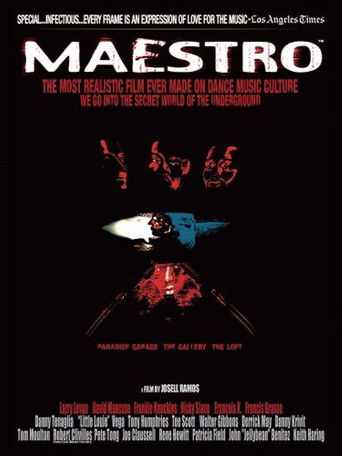
Maestro (2003)
The most realistic film made on dance music culture
Maestro, tells the story of how a group of people found refuge and a call for life outside the mainstream. What evolved was a scene that set the ground work for what was to come in dance music culture worldwide, a rare insight into the secret underground world. It's the first time this story is told in a motion Picture, included in the film are pioneer dance music DJs and producers, "founding fathers", its center being Larry Levan, as well as high-profile DJs of today. Opting for a more personal and candid approach, MAESTRO shows the true history of the people through a realistic creative aesthetic. Tracing the underground's dance origin, MAESTRO brings out a real understanding of this intense lifestyle, and the lives they lived and died for. Written by Anonymous
- Date of release
- 2003-02-22
- TMDB
- 5.4 / 10 (9)
- Runtime
- 1h 29m
- Genres
- Documentary
- Director
- Josell Ramos
Casting
- Larry Levan — Self
- David Mancuso — Self
- Frankie Knuckles — Self
- Nicky Siano — Self
- Francis Grasso — Self
- Patricia Field — Self
- Keith Haring — Self
- François Kevorkian — Self
- Louis Vega — Self
- Danny Tenaglia — Self
- Tony Humphries — Self
- Jellybean Benítez — Self
Interesting facts
Maestro is an American documentary film written, directed, filmed, edited, and produced by Josell Ramos. It details the rise of the house music clubs of the 1970s in New York City, covering how the AIDS epidemic affected both patrons and owners, and was the only full-length documentary film prior to 2016 covering the Paradise Garage.
Production
The film grew out of a half hour television piece Ramos had been writing on the underground music scene in 1997, and took more than four years to make. Ramos stated that they garnered trust among the house music scene by conveying the truth of its history. The footage of Keith Haring, for example, came from Michael Sampson, a former roommate of Levan's, and it took Ramos two years to gain his trust to be able to include it.
Maestro had three different subtitles: "The Origins of Dance Music Culture," "Larry Levan and early DJ culture," and "Larry Levan and the Paradise Garage." Lawrence Kennibrew narrated the opening sequence, with Ramos narrating the blue scene after François K's appearance. Scott Sterling provided the soprano.
Artrution Productions and Door A served as production companies for the film. Editors for the film were Ramos, Eric Moorman, and Sara Kraushaar. Much of Maestro's footage consists of Super 8 film, 16 mm film, and digital camcorder sequences. The film is presented with some segments in color and others in black and white.
Antonio Ocasio served as the music director for the film, along with composing original pieces to complement the vintage tracks used. Jephté Guillaume and Michael Cole also created original music pieces for the documentary, along with Raw Habits.
In addition to editing and narration, Ramos also wrote, directed, and produced the film, as well as handling the cinematography. With respect to the camera, Ramos said that the lighting and camera choices in the film were made in an effort to keep interviewees from feeling self-conscious. He also stated that he intentionally edited it so that the audience received the information non-linearly.
Read on Wikipedia · Text from Wikipedia, CC BY-SA 4.0. Data from Wikidata.
Recommended
- Above Majestic 2018 · ★ 7.4
- Seduced and Abandoned 2013 · ★ 6.2
- Trainwreck: The Real Project X 2025 · ★ 5.9
- The Curious Birth of Benjamin Button 2009 · ★ 7.0
- 28 Up 1985 · ★ 7.5
- The Class of ‘92 2013 · ★ 7.1
- 35 Up 1991 · ★ 7.6
- As I Was Moving Ahead Occasionally I Saw Brief Glimpses of Beauty 2000 · ★ 7.8
- Ex Libris: The New York Public Library 2017 · ★ 6.4
- Come See Me in the Good Light 2025 · ★ 7.1
- 21 Up 1977 · ★ 7.4
- McQueen 2018 · ★ 7.4