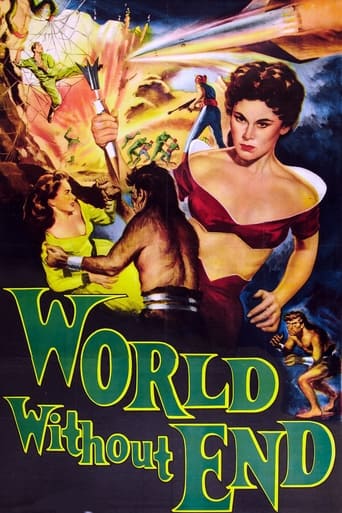
World Without End (1956)
Thru the Time Barrier, 552 years Ahead... Roaring To the Far Reaches of Titanic Terror, Crash-Landing Into the Nightmare Future!
Four astronauts returning from man's first mission to Mars enter a time warp and crash on a 26th-century Earth devastated by atomic war. At first unaware where they are, but finding the atmosphere safe to breathe, they start exploring and find themselves in a divided future where disfigured mutants living like cavemen inhabit the surface, while the normals live comfortably below the surface but are dying as a race from lack of natural water, air and sunlight.
- Date of release
- 1956-03-25
- TMDB
- 5.7 / 10 (61)
- Runtime
- 1h 20m
- Genres
- Science Fiction, Adventure
- Director
- Edward Bernds
Casting
- Hugh Marlowe — John Borden
- Nancy Gates — Garnet
- Rod Taylor — Herbert Ellis
- Lisa Montell — Deena
- Nelson Leigh — Dr Eldon Galbraithe
- Christopher Dark — Henry Jaffe
- Everett Glass — Timmek
- Booth Colman — Mories
- Shirley Patterson — Elaine
- Stanley Fraser — Elda
- William Vedder — James (uncredited)
- Mickey Simpson — Naga (uncredited)
Interesting facts
World Without End is a 1956 American science fiction film directed by Edward Bernds and starring Hugh Marlowe and Nancy Gates. It was made in CinemaScope and Technicolor by Allied Artists and produced by Richard Heermance.
Production
Under the working title, Flight to the Future, principal photography took place from July 19 to early August 1955. Locations included the Iverson Movie Ranch in Chatsworth, California.
Edward Bernds was a prolific director with experience in both television and cinema, and worked in many different genres. In 1956, he also helmed the comedy Navy Wife and crime thriller Calling Homicide. In directing World Without End, Bernds "crammed" in order to make a science fiction film. He studied Albert Einstein's theory of relativity to give his space and time travellers a plausible way to go into the future.
World Without End was partly made in order to reuse footage and costumes from the earlier Allied Artists science fiction film Flight to Mars (1951). A number of people who worked on the film went on to have notable film careers, including Sam Peckinpah (dialogue director) and Walter Mirisch (an executive at Allied Artists). Alberto Vargas (set sketches) was a famed artist whose only screen credit was World Without End.
Read on Wikipedia · Text from Wikipedia, CC BY-SA 4.0. Data from Wikidata.
Recommended
- Moonshot 2022 · ★ 6.5
- Star Trek II: The Wrath of Khan 1982 · ★ 7.4
- Mission to Mars 2000 · ★ 6.0
- 65 2023 · ★ 5.9
- Valerian and the City of a Thousand Planets 2017 · ★ 6.7
- Avatar 2009 · ★ 7.6
- Finch 2021 · ★ 7.8
- John Carter 2012 · ★ 6.4
- Star Trek Beyond 2016 · ★ 6.8
- Star Trek 2009 · ★ 7.4
- 9 2009 · ★ 7.0
- Escape from the Planet of the Apes 1971 · ★ 6.4