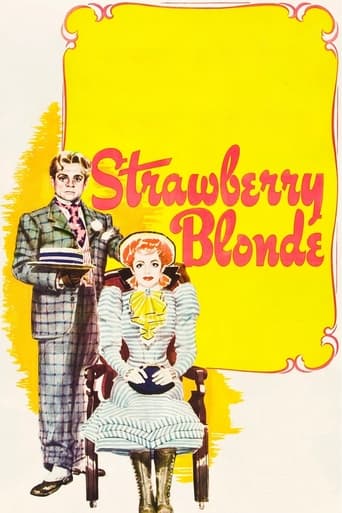
The Strawberry Blonde (1941)
Biff Grimes is desperately in love with Virginia, but his best friend Hugo marries her and manipulates Biff into becoming involved in his somewhat nefarious businesses. Hugo appears to have stolen Biff's dreams, and Biff has to deal with the realisation that having what he wants and wanting what another has can be very different things.
- Data lansării
- 1941-02-21
- TMDB
- 6.9 / 10 (73)
- Durată
- 1 h 37 min
- Genuri
- Romantic, Comedie
- Regizor
- Raoul Walsh
Distribuție
- James Cagney — Biff Grimes
- Olivia de Havilland — Amy Lind
- Rita Hayworth — Virginia Brush
- Alan Hale — Old Man Grimes
- Jack Carson — Hugo Barnstead
- George Tobias — Nicholas Pappalas
- Una O'Connor — Mrs. Mulcahey
- George Reeves — Harold
- Lucile Fairbanks — Harold's Girl Friend
- Edward McNamara — Big Joe
- Helen Lynd — Josephine
- Herbert Heywood — Toby
Curiozități
- Premii: 0 · Nominalizări: 1
The Strawberry Blonde is a 1941 American romantic comedy drama film directed by Raoul Walsh, starring James Cagney and Olivia de Havilland, and featuring Rita Hayworth, Alan Hale, Jack Carson, and George Tobias. Set in 1890s New York City, it features songs of that era such as "The Band Played On", "Bill Bailey", "Meet Me in St. Louis, Louie", "Wait Till The Sun Shines Nellie", and "Love Me and the World Is Mine". It was nominated for an Academy Award in 1941 for Best Scoring of a Musical Picture.
Development and production
Both the director of Strawberry Blonde, Raoul Walsh, and its star James Cagney came to the project looking for a change of pace. Walsh had just completed the dark Humphrey Bogart/Ida Lupino vehicle High Sierra, shot largely on location, and the good notices the film received had Walsh "as fired up as Jack Warner to keep the ball rolling on projects in development and production." The transition between the outdoorsy film noir and the light and se…
Cagney usually played tough guys at Warner Bros. Pictures in the early 1930s, but he had shown his talents at lighter, musical material in films like Footlight Parade (1933) He left the studio in mid-decade, then returned in 1938 with a contract that gave him more control in choosing roles and brought his younger brother William Cagney as assistant producer and informal buffer between himself and studio executives.
A property on the lot that might fill that bill was One Sunday Afternoon. It had started early in 1933 as a successful Broadway play by James Hagan and had been adapted later that year by Paramount as a vehicle for Gary Cooper. It was "the only real flop of Cooper's stellar and carefully orchestrated career"—and the only Cooper picture ever to lose money.
Wallis knew the trick was to tailor the script as a vehicle for Cagney, who had yet to commit either to the project or even to his brother. Wallis had a first draft of a screenplay done by Stephen Morehouse Avery that satisfied no one; he called in the Epstein brothers, Julius and Phillip, for another vision—one that might hook Cagney into the project.
Cagney still was reluctant. Wallis was getting impatient; he considered the emerging John Garfield for the role of Biff Grimes. By July 1940, concern about the impasse stretched all the way to New York, where Harry Warner cabled brother Jack that he was willing to give Cagney 10% of the gross, and then Cagney began to budge.
Citește pe Wikipedia · Text din Wikipedia, CC BY-SA 4.0. Date din Wikidata.
Recomandate
- Şi dragostea unde e? 2023 · ★ 6.1
- John Tucker trebuie să moară 2006 · ★ 6.1
- Eu și prințul 4: Vizita regală 2010 · ★ 6.1
- Dragostea este în aer 2023 · ★ 6.2
- Mireasa e iubita mea! 2008 · ★ 6.5
- Secrete din trecut 2008 · ★ 6.5
- Watching the Detectives 2007 · ★ 6.3
- Whisky Galore 2016 · ★ 5.9
- Țara Viselor 2022 · ★ 7.2
- Angels in the Outfield 1994 · ★ 6.1
- You're Never Too Young 1955 · ★ 6.6
- Hai să facem dragoste 1960 · ★ 6.4