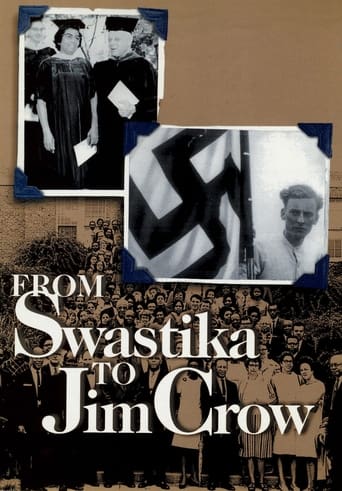
From Swastika to Jim Crow (2000)
Before and during the Second World War, Jewish intellectuals and scholars who escaped Nazi Germany and immigrated to the U.S. faced an uncertain future. Confronted with anti-Semitism at major universities and a public distrust of foreigners, a surprising number secured teaching positions at traditionally Black colleges in the segregated South. In many cases they formed lasting relationships with their students and had an important impact on the communities in which they lived and worked. This is a story of two cultures, each sharing a burden of oppression, brought together by the tragic circumstances of war. The film also highlights the role of African Americans such as Ralph Bunche in securing positions for these refugee scholars at places like Howard University, Tougaloo College and Hampton Institute.
- Date of release
- 2000-01-01
- TMDB
- 7.0 / 10 (1)
- Runtime
- 1h 0m
- Genres
- Documentary, History
- Director
- Martin D. Toub, Lori Cheatle
Casting
- John Hope Franklin — John Hope Franklin
- Lucy Sante — Narrator
Interesting facts
From Swastika to Jim Crow is a 2000 documentary that explores the similarities between Nazism in Germany and racism in the American south. In 1939, the Nazi government expelled Jewish scholars from German universities. Many of them found teaching positions in Southern universities, where they sympathized with the plight of their African-American colleagues and students.
Production
From Swastika to Jim Crow was inspired by a New York Times editorial. The letter writer was upset by the fact that antisemitic sentiment was being spouted by speech givers at Howard University and other predominantly African-American schools. The editorialist mentioned the book From Swastika to Jim Crow and lamented the past, when Jewish professors found refuge at Southern universities.
Read on Wikipedia · Text from Wikipedia, CC BY-SA 4.0. Data from Wikidata.
Recommended
- The Untold History Of The United States 2012 · ★ 8.2
- Making Waves: The Art of Cinematic Sound 2019 · ★ 6.9
- The War Room 1993 · ★ 6.8
- Visions of Light 1992 · ★ 7.0
- The Unknown Known 2013 · ★ 6.9
- Red Army 2015 · ★ 7.3
- The War on Democracy 2007 · ★ 7.5
- Nazi Concentration Camps 1945 · ★ 7.7
- Be Natural: The Untold Story of Alice Guy-Blaché 2018 · ★ 7.2
- The Mystery of D.B. Cooper 2020 · ★ 6.4
- Fuck 2006 · ★ 6.4
- The Cutting Edge: The Magic of Movie Editing 2004 · ★ 7.0