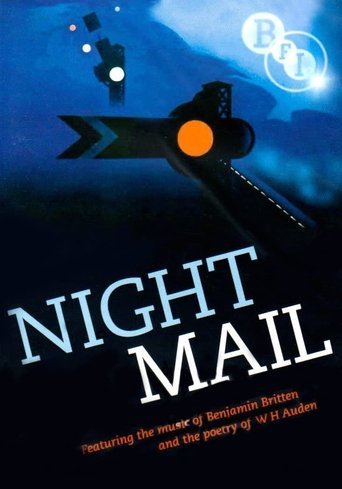
Night Mail (1938)
This documentary short examines the special train on which mail is sorted, dropped and collected on the run, and delivered in Scotland on the overnight run from Euston, London to Glasgow.
- Date of release
- 1938-05-13
- TMDB
- 6.2 / 10 (38)
- Runtime
- 25m
- Genres
- Documentary
- Director
- Harry Watt, Basil Wright
Casting
- Arthur Clark — Self - Engineer
- John Grierson — Commentary (voice)
- Stuart Legg — Commentary (voice)
- Robert Rae — Self - Senior Driver - LMS Railway
Interesting facts
Night Mail is a 1936 British documentary film directed by Harry Watt and Basil Wright for the General Post Office (GPO) Film Unit. Widely considered a masterpiece of the British Documentary Film Movement, the 24-minute film chronicles the overnight journey of the London, Midland and Scottish Railway's (LMS) postal train as it transports mail from London's Euston station to Scotland. Commissioned by John Grierson to portray a modern, reliable civil service, the production is celebrated for its innovative avant-garde synthesis of image, sound, and editing, culminating in a famous lyrical sequence featuring a rhythmic musical score by Benjamin Britten and spoken-verse commentary by W. H. Auden.
Production
Production lasted for four months. Due to technological constraints, the majority of Night Mail was shot as a silent film with the sound, dialogue, and music added in post-production. Jackson recalled there was not "a great deal" of synchronised sound filming while on location, barring some "fragments".
The background sound was recorded in various locations, with the crew using the studio's sound van. This included recording at Bletchley station, where the crew recorded passing trains and instructed drivers to pass the station at speed while blowing the whistle so they could get a sound that gradually fades.
The platelayers were filmed several miles north of Hemel Hempstead as the film crew walked along the track to obtain shots of any railway action, including passing trains and the movement of signals and points. They were joined by a "ganger", an employee of the LMS who alerted the team of oncoming trains and guided them to the sidewalk.
Filming at Crewe station for the train's 13-minute stop took several days, and involved the team setting up their own scaffolding and arc lamps and electrician Frank Brice running power cables onto the track to supply power from their generator. Once finished, the equipment was packed in time for arrival of the postal train bound for London.
Wright was responsible for the aerial shots of the train from a hired aircraft, while Watt filmed the interior and location shots. The men in the sorting coach were real Post Office workers, but filmed in a reconstructed set built at the GPO's studio in Blackheath. They were instructed to sway from side to side to recreate the motion of the moving train which was accomplished by following the movement of a suspended piece of string.
Read on Wikipedia · Text from Wikipedia, CC BY-SA 4.0. Data from Wikidata.
Recommended
- 180° South 2010 · ★ 7.2
- The Secret 2006 · ★ 6.6
- A Love Song for Latasha 2019 · ★ 7.0
- The Irishman: In Conversation 2019 · ★ 7.5
- Oasis: Don't Look Back in Anger 2026 · ★ 7.1
- American Boy: A Profile of Steven Prince 1978 · ★ 6.7
- The Summers of It - Chapter Two: It Ends 2019 · ★ 7.1
- Capital in the Twenty-First Century 2019 · ★ 6.5
- The Crystal Calls - Making The Dark Crystal: Age of Resistance 2019 · ★ 7.5
- David Byrne's American Utopia 2020 · ★ 7.5
- Justin Bieber's Believe 2013 · ★ 6.9
- Western Stars 2019 · ★ 7.0