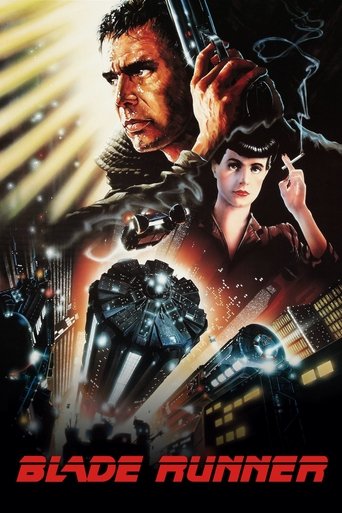
Blade Runner (1982)
Man has made his match ...now it's his problem.
In the smog-choked dystopian Los Angeles of 2019, blade runner Rick Deckard is called out of retirement to terminate a quartet of replicants who have escaped to Earth seeking their creator for a way to extend their short life spans.
- Date of release
- 1982-06-25
- TMDB
- 7.9 / 10 (15694)
- Runtime
- 1h 58m
- Genres
- Science Fiction, Drama, Thriller
- Director
- Ridley Scott
- Collection
- Blade Runner Collection
Casting
- Harrison Ford — Deckard
- Rutger Hauer — Batty
- Sean Young — Rachael
- Edward James Olmos — Gaff
- M. Emmet Walsh — Bryant
- Daryl Hannah — Pris
- William Sanderson — Sebastian
- Brion James — Leon
- Joe Turkel — Tyrell
- Joanna Cassidy — Zhora
- James Hong — Chew
- Morgan Paull — Holden
Interesting facts
- Box office: $41.7M
- Budget: $28M
- Earned 1.5× its budget
- Based on: Do Androids Dream of Electric Sheep?
- Filmed in: Los Angeles
- Awards: 4 · Nominations: 12. Including: Los Angeles Film Critics Association Award for Best Cinematography; BAFTA Award for Best Cinematography; BAFTA Award for Best Production Design; Hugo Award for Best Dramatic Presentation
Blade Runner is a 1982 science fiction film directed by Ridley Scott from a screenplay by Hampton Fancher and David Peoples. Starring Harrison Ford, Rutger Hauer, Sean Young, and Edward James Olmos, it is an adaptation of the 1968 novel Do Androids Dream of Electric Sheep? by Philip K. Dick. The film is set in a dystopian future Los Angeles of 2019, in which synthetic humans known as replicants are bio-engineered by the powerful Tyrell Corporation to work on space colonies. When a fugitive group of advanced replicants led by Roy Batty (Hauer) escapes back to Earth, former cop Rick Deckard (Ford) is recalled to hunt them down.
Production
Interest in adapting Philip K. Dick's novel Do Androids Dream of Electric Sheep? developed shortly after its 1968 publication. Director Martin Scorsese was interested in filming the novel, but never optioned it. Producer Herb Jaffe optioned it in the early 1970s, but Dick was unimpressed with the screenplay written by Herb's son Robert, saying, "Jaffe's screenplay was so terribly done ...
The screenplay by Hampton Fancher was optioned in 1977. Producer Michael Deeley became interested in Fancher's draft and convinced director Ridley Scott to film it. Scott had previously declined the project but, after leaving the slow production of Dune, wanted a faster-paced project to take his mind off his older brother's recent death.
Dick publicly expressed distaste with Fancher's early screenplay in the LA press, calling the result a "terrible script. Corny, extremely maladroit throughout". He complained that it "overrelied on the old cliché-ridden Chandleresque figure" and that Fancher had "concentrated on a lurid collision between human and android.
This was the February 1981 version of the script, and it immediately struck me that all the previous problems had been resolved. Peoples had done a first-class piece of work. He'd smoothed out the dialogue and reworked certain problems in some of the scenes. And the whole idea of the replicants being infused with progeria, or premature aging, was a new twist.
Peoples later suggested that his contributions were oversold, stating that Scott's "ideas and thrust were the motive force of the film" and noting that Scott was "totally involved on every level of scripting." He also praised an early script by Fancher, and credited actors Harrison Ford and Rutger Hauer with offering ideas about dialogue.
Read on Wikipedia · Text from Wikipedia, CC BY-SA 4.0. Data from Wikidata.
Recommended
- Blade Runner 2049 2017 · ★ 7.6
- The Terminator 1984 · ★ 7.7
- Upgrade 2018 · ★ 7.5
- Cloud Atlas 2012 · ★ 6.9
- 2073 2024 · ★ 6.7
- Terminator Salvation 2009 · ★ 6.1
- Impostor 2001 · ★ 6.1
- A Scanner Darkly 2006 · ★ 6.8
- Wifelike 2022 · ★ 6.5
- The Island 2005 · ★ 6.7
- Terminator 3: Rise of the Machines 2003 · ★ 6.2
- Archive 2020 · ★ 6.4