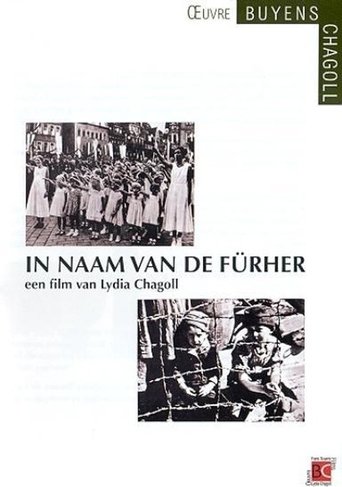
In naam van de Führer (1978)
This film deals with the fate of children during the Second World War. The Nazis divided children into two categories: “the good ones,” the Aryan children, and “the bad ones,” the others. In the name of ultranationalism, Nazism, the theory of the Übermensch, and racism, Aryan children were mentally indoctrinated, while the others were imprisoned in camps and physically destroyed. These “others” were mainly children from non-Aryan and supposedly impure races: Jews, Poles, Russians, Yugoslavs, and Roma. For this film, Lydia Chagoll conducted research in World War II documentation centers, museums, and concentration camp archives in several countries, collecting texts, documents, and photographs. The film consists of a montage of photos and footage filmed by the Nazis themselves, accompanied by voice-over commentary based entirely on quotations from Nazi publications, laws, decrees, directives, newspapers, schoolbooks, reports, and political texts.
- Date of release
- 1978-05-11
- TMDB
- 9.0 / 10 (1)
- Runtime
- 1h 27m
- Genres
- Documentary
- Director
- Lydia Chagoll
Interesting facts
In the Name of the Führer is a 1977 Belgian documentary film directed by Lydia Chagoll. It received the André Cavens Award for Best Film given by the Belgian Film Critics Association (UCC).
Read on Wikipedia · Text from Wikipedia, CC BY-SA 4.0. Data from Wikidata.
Recommended
- Night Will Fall 2014 · ★ 7.6
- My Mom Jayne 2025 · ★ 8.0
- Nazi Concentration Camps 1945 · ★ 7.7
- Hôtel Terminus: The Life and Times of Klaus Barbie 1988 · ★ 7.1
- Fuck 2006 · ★ 6.4
- Deliver Us from Evil 2006 · ★ 7.2
- The Curse of the Dragon 1993 · ★ 7.2
- 4 Little Girls 1997 · ★ 7.1
- As I Was Moving Ahead Occasionally I Saw Brief Glimpses of Beauty 2000 · ★ 7.8
- In the Realms of the Unreal 2004 · ★ 7.2
- The Green Book: Guide to Freedom 2019 · ★ 7.8
- Louis Theroux: Louis and the Nazis 2003 · ★ 7.2