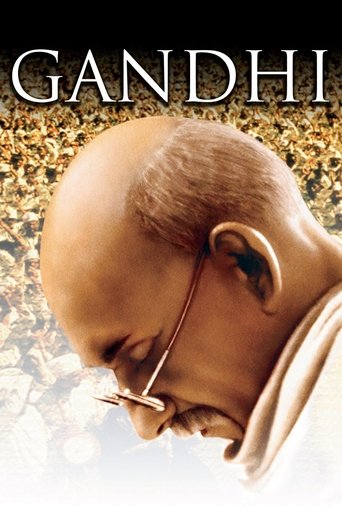
Gandhi (1982)
His triumph changed the world forever.
In the early years of the 20th century, Mohandas K. Gandhi, a British-trained lawyer, forsakes all worldly possessions to take up the cause of Indian independence. Faced with armed resistance from the British government, Gandhi adopts a policy of 'passive resistance', endeavouring to win freedom for his people without resorting to bloodshed.
- Date of release
- 1982-12-01
- TMDB
- 7.6 / 10 (2630)
- Runtime
- 3h 12m
- Genres
- Drama, History
- Director
- Richard Attenborough
Casting
- Ben Kingsley — Mahatma Gandhi
- Candice Bergen — Margaret Bourke-White
- Edward Fox — General Dyer
- John Gielgud — Lord Irwin
- Trevor Howard — Judge Broomfield
- John Mills — Lord Chelmsford
- Rohini Hattangadi — Kasturba Gandhi
- Martin Sheen — Vince Walker
- Ian Charleson — Reverend Charlie Andrews
- Harsh Nayyar — Nathuram Godse
- Athol Fugard — General Jan Christiaan Smuts
- Günther Maria Halmer — Dr. Herman Kallenbach
Interesting facts
- Box office: $52.8M
- Budget: $22M
- Earned 2.4× its budget
- Awards: 10 · Nominations: 11. Including: Academy Award for Best Picture; Academy Award for Best Actor; Academy Award for Best Director; Academy Award for Best Cinematography
Gandhi is a 1982 biographical film directed and produced by Richard Attenborough and written by John Briley. It is based on the life of Mahatma Gandhi, a major leader in the Indian independence movement against the British Empire during the 20th century. It covers Gandhi's life from a defining moment in 1893, as he is thrown off a train in the Colony of Natal for being in a whites-only compartment and concludes with his assassination and funeral in 1948. Although a practising Hindu, Gandhi's embracing of other faiths, particularly Christianity and Islam, is also depicted. Over 300,000 extras appeared in the film, believed to be the most in any film made.
Production
This film had been Richard Attenborough's dream project, although two previous attempts at filming had failed. In 1952, Gabriel Pascal secured an agreement with the Prime Minister of India (Jawaharlal Nehru) to produce a film of Gandhi's life. However, Pascal died in 1954 before preparations were completed.
In 1962, Attenborough was contacted by Motilal Kothari, an Indian-born civil servant working with the Indian High Commission in London and a devout follower of Gandhi. Kothari insisted that Attenborough meet him to discuss a film about Gandhi. Attenborough agreed, after reading Louis Fischer's biography of Gandhi and spent the next 18 years attempting to get the film made.
David Lean and Sam Spiegel had planned to make a film about Gandhi after completing The Bridge on the River Kwai, reportedly with Alec Guinness as Gandhi. Ultimately, the project was abandoned in favour of Lawrence of Arabia (1962). Attenborough reluctantly approached Lean with his own Gandhi project in the late 1960s, and Lean agreed to direct the film and offered Attenborough the lead role.
Attenborough again attempted to resurrect the project in 1976 with backing from Warner Bros. Then prime minister Indira Gandhi declared a state of emergency in India and filming would be impossible. Co-producer Rani Dube persuaded prime minister Indira Gandhi to provide the first $10 million from the National Film Development Corporation of India, chaired by D. V. S.
Filming began on 26 November 1980 and ended on 10 May 1981. Some scenes were shot near Koilwar Bridge, in Bihar. Over 300,000 extras were used in the funeral scene, the most for any film, according to Guinness World Records.
Read on Wikipedia · Text from Wikipedia, CC BY-SA 4.0. Data from Wikidata.
Recommended
- Some Mother's Son 1996 · ★ 6.8
- Palestine 36 2025 · ★ 7.6
- Lion of the Desert 1981 · ★ 7.3
- Mandela: Long Walk to Freedom 2013 · ★ 6.8
- Shirley 2024 · ★ 6.6
- The Wind and the Lion 1975 · ★ 6.5
- The Boy Who Harnessed the Wind 2019 · ★ 7.9
- Passage to Marseille 1944 · ★ 6.7
- Uprising 2001 · ★ 6.6
- The Way Back 2010 · ★ 7.0
- The Great Debaters 2007 · ★ 7.3
- The Immortal Life of Henrietta Lacks 2017 · ★ 6.3