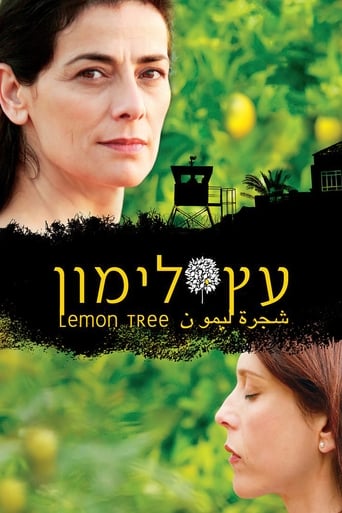
עץ לימון (2008)
Salma Zidane, a widow, lives simply from her grove of lemon trees in the West Bank's occupied territory. The Israeli defence minister and his wife move next door, forcing the Secret Service to order the trees' removal for security. The stoic Salma seeks assistance from the Palestinian Authority, Israeli army, and a young attorney, Ziad Daud, who takes the case. In this allegory, does David stand a chance against Goliath?
- Data lansării
- 2008-02-08
- TMDB
- 7.0 / 10 (128)
- Durată
- 1 h 46 min
- Genuri
- Dramă
- Regizor
- Eran Riklis
Distribuție
- Hiam Abbass — Selma Zidane
- Tarik Kopty — Abu Hussam
- Ali Suliman — Ziad Daud
- Doron Tavory — Defense Minister Israel Navon
- Rona Lipaz-Michael — Mira Navon
- Amos Lavi — Commander Jacob
- אמנון וולף — Leibowitz
- לירון ברנס — Gilad
- Smadar Jaaron — Tamar Gera
- Danny Leshman — Private Itamar 'Quickie'
- איילת רובינסון — Shelly
- לואי נופי — Nasser Zidane
Curiozități
- Premii: 0 · Nominalizări: 2
Lemon Tree is a 2008 drama film directed by Eran Riklis, co-written by Suha Arraf. Starring Hiam Abbass, Ali Suliman, Danny Leshman and Rona Lipaz-Michael, it follows the legal efforts of a Palestinian widow to stop the Israeli Defense Minister, her new next door neighbor, from destroying the lemon trees in her family farm. At the same time, she develops a human bond with the minister's wife.
Production
Director Eran Riklis covered personal relationships between Arabs and Middle Eastern Jews in his previous films The Syrian Bride and Cup Final. The former film, which also starred Hiam Abbass, achieved widespread success in Israel as well as with international audiences after its 2004 release. This boosted Riklis's expectations for the future.
The plot of Lemon Tree was based on a real-life incident. Israeli Defense Minister Shaul Mofaz moved to the border within Israel and the occupied territories and security forces began cutting down the lemon trees beside his house, arguing that it could be used by terrorists as a hiding place. The Palestinian family who owned the trees sued the minister and took the case all the way to the Israeli Supreme Court.
The characters in the film speak Arabic and Hebrew. Riklis' personal company, Eran Riklis Production, filmed the movie. It was shot in the cities of Qalqilya and Ramallah and the Jalazone refugee camp as well on location at and around the Supreme Court of Israel building in Sha'arey Mishpat Street, Jerusalem. Salon film critic Andrew O'Hehir has commented, "Riklis forges into areas other Israeli filmmakers won't venture."
Riklis designed the film to be essentially apolitical, focusing on character development rather than exploring the issues of the Israeli–Palestinian conflict. He has said that he created a 'fairy tale quality' to the film in which the audience can sympathize with all of the people featured in it.
Andrew O'Hehir argued that Riklis "depicts all versions of Middle Eastern authority with a cheerful, agnostic cynicism", portraying the Palestinian government as "corrupt and obsessed with status and protocol" and the Israeli government as "hypocritical and mindlessly bureaucratic." V. A. Musetto of the New York Post argued that the movie expresses Riklis' opposition to Israeli policies of confiscation of Palestinian land.
Citește pe Wikipedia · Text din Wikipedia, CC BY-SA 4.0. Date din Wikidata.
Recomandate
- Călătorie către regăsire 2019 · ★ 6.1
- The Young One 1960 · ★ 7.0
- Gett: The Trial of Viviane Amsalem 2014 · ★ 7.5
- Furtună în deșert 2016 · ★ 6.0
- Omul care aduce ploaia 1997 · ★ 7.0
- 1 2020 · ★ 6.7
- Procesele lui Cate McCall 2013 · ★ 6.4
- Cazul lui Richard Jewell 2019 · ★ 7.4
- Râul 1984 · ★ 6.4
- Mărul discordiei 2008 · ★ 6.0
- Copacul 2010 · ★ 6.4
- Foxtrot 2017 · ★ 6.7