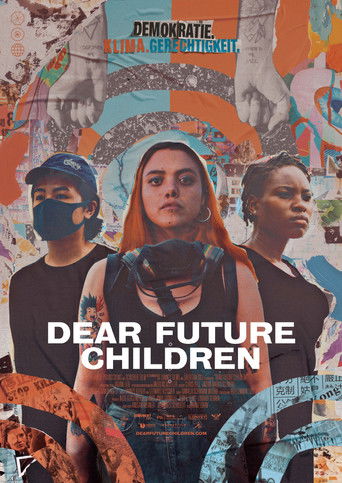
Dear Future Children (2021)
Trois jeunes militantes en Ouganda, à Hong Kong et au Chili font front commun pour l'avenir, dans un film enflammé d'un cinéaste à peine âgé de 21 ans.
Dear Future Children est un film documentaire réalisé par Franz Böhm sur le jeune militantisme dans le monde. La coproduction germano-britannique-autrichienne donne un aperçu de la vie de trois jeunes militants de Hong Kong, d'Ouganda et du Chili et examine l'impact sur leur vie quotidienne
- Date de sortie
- 2021-10-14
- TMDB
- 7.9 / 10 (9)
- Durée
- 1 h 28 min
- Genres
- Documentaire
- Réalisateur
- Franz Böhm
Anecdotes
Dear Future Children is a 2021 documentary film directed by Franz Böhm about young activism worldwide. The German-British-Austrian co-production provides insights into the lives of three young activists from Hong Kong, Uganda and Chile and examines the impact on their daily lives. The film premiered on 18 January 2021 at the 42nd Max Ophüls Prize Film Festival, which was held online due to the COVID-19 pandemic.
Filming
The film team was led by director Franz Böhm and DOP Friedemann Leis, who travelled to the locations exclusively as a team of two. At the destinations in Hong Kong, Uganda, Chile and Denmark, young local filmmakers were involved to provide significant support. In addition, cooperation with various local and international NGOs, institutions and media was formed in all countries.
Some filming on the frontline of the demonstrations was done strictly in teams of two for security reasons. Böhm and Leis consulted with local supporters via radio.
On 30 January 2020, while filming in Chile, a policeman shot director Franz Böhm at close range, hitting him in the back of the head with a rubber bullet. However, due to appropriate safety clothing (protective clothing, gas mask, helmet) Böhm did not suffer any serious injury.
At the end of June 2020, Franz Böhm travelled to Hong Kong a second time to talk to Pepper about new developments and the situation during the National Security Law.
Lire sur Wikipédia · Texte de Wikipédia, CC BY-SA 4.0. Données de Wikidata.
Recommandés
- Amour et Machinations 2026 · ★ 6.4
- Come See Me in the Good Light 2025 · ★ 7.1
- Fuck 2006 · ★ 6.4
- Tuer un tigre 2023 · ★ 7.6
- Les féministes : À quoi pensaient-elles ? 2018 · ★ 7.5
- Chaos d'anthologie : Le film d'une fête trop virale 2025 · ★ 5.8
- Celle que vous croyez connaître : Anna Nicole Smith 2023 · ★ 6.1
- Bruce Lee, la malédiction du dragon 1993 · ★ 7.2
- McQueen 2018 · ★ 7.4
- Mauvaise influenceuse : L'histoire de Jodi Hildebrandt 2025 · ★ 6.2
- Fille montante 2013 · ★ 7.0
- Une décennie sous influence 2003 · ★ 7.9