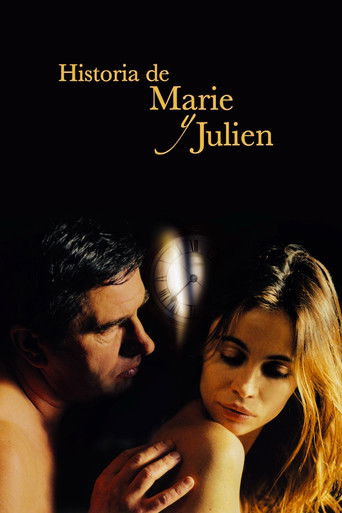
La historia de Marie y Julien (2003)
Histoire de Marie et Julien
Julien, un relojero de unos cuarenta años, dominado por impulsos destructivos, decide chantajear a Madame X, una rica y atractiva mujer que trafica con antigüedades robadas. Lo que Julien no sabe es que Madame X guarda un secreto aún más peligroso, que lo llevará hasta Marie, la mujer de la que Julien se enamoró hace un año y que ha reaparecido misteriosamente. Marie tiene un comportamiento enigmático y, a pesar de que el amor entre ambos no deja de crecer parece incapaz de cualquier sentimiento físico. Julien, que ha recuperado la alegría de vivir, está dispuesto a desvelar el misterio y a ayudar a Marie a liberarse. Juntos irán todo lo lejos que un hombre y una mujer pueden ir, a un lugar donde las preguntas sobre la vida y la muerte, sobre el miedo y la esperanza, ya no existen. Un lugar regido por el amor sin límites.
- Fecha de estreno
- 2003-09-10
- TMDB
- 6.5 / 10 (30)
- Duración
- 2 h 25 min
- Géneros
- Drama, Romance, Misterio, Fantasía
- Director
- Jacques Rivette
Reparto
- Emmanuelle Béart — Marie
- Jerzy Radziwiłowicz — Julien Müller
- Anne Brochet — Madame X
- Bettina Kee — Adrienne
- Olivier Cruveiller — l'éditeur
- Mathias Jung — le concierge
- Nicole Garcia — l'amie
Curiosidades
The Story Of Marie And Julien is a 2003 French romantic drama film co-written and directed by Jacques Rivette. The film slowly develops from a drama about blackmail into a dark, yet tender, supernatural love story between Marie and Julien, played by French actress Emmanuelle Béart and Polish actor Jerzy Radziwiłowicz. Anne Brochet plays the blackmailed Madame X. Béart had previously worked with Rivette in La Belle Noiseuse, as had Radziwiłowicz in Secret Defense. The film was shot by William Lubtchansky, and edited by Nicole Lubtchansky, both frequent collaborators of Rivette's.
Production
Rivette originally began to make Marie et Julien, as it was then titled, in 1975 with producer Stéphane Tchalgadjieff as part of a series of four films he first called Les filles du feu and later Scènes de la Vie Parallele. Rivette said in 2003 that the film was based on the true story of a woman who committed suicide.
After Rivette had later success with La Belle Noiseuse and Va Savoir in the 1990s, he revisited his older unproduced screenplays. With Hélène Frappat, he published in book form three of his "phantom films" including Marie et Julien in 2002.
Rivette worked with scriptwriters Pascal Bonitzer and Christine Laurent using an automatic writing approach that involved writing the script day by day; the actors and filmmakers did not know the direction of the story in advance of each day's filming. Eurimages provided €420,000 of funding in July 2002, and the film was shot that autumn and winter. Rivette immediately thought of Béart, who starred in La Belle Noiseuse, to play the carnal Marie.
The film illustrates Rivette's view that the act of watching cinema involves game-playing, day-dreaming and paranoid fantasy. He leaves aside the usual devices of the horror genre—no music, shock sound effects, special effects, or gore—evoking feelings and scenes verbally rather than showing them, yet he does employ Hitchcockian "MacGuffins" such as chance encounters, "clues," and the blackmail plot-line.
Film critic Glenn Kenny has said that the "calm precision" of the mise en scène in the opening dream sequence "put [him] under such a powerful spell" that "it reconfirmed ... Rivette's standing as an ultimately unquantifiable master". Throughout the film, everyday sounds are amplified by a lack of music, and the film uses sweeping long shots, and several incidental scenes of Julien working, talking with his cat, and of the characters sleeping.
Leer en Wikipedia · Texto de Wikipedia, CC BY-SA 4.0. Datos de Wikidata.
Recomendadas
- Cuento de invierno 2014 · ★ 6.3
- El romance de Astrea y Celadón 2007 · ★ 5.9
- Sueño de amor eterno 1935 · ★ 7.0
- Posesión 2002 · ★ 6.0
- Solo para mi 2023 · ★ 6.9
- La lectora 2017 · ★ 6.1
- Una doble vida 1959 · ★ 5.8
- Una pasión oculta (Thérèse Raquin) 2014 · ★ 6.1
- Perfectos mentirosos 2026 · ★ 7.1
- Hélas pour moi 1993 · ★ 6.2
- Órbita 9 2017 · ★ 5.8
- Teresa Raquin 1953 · ★ 6.7