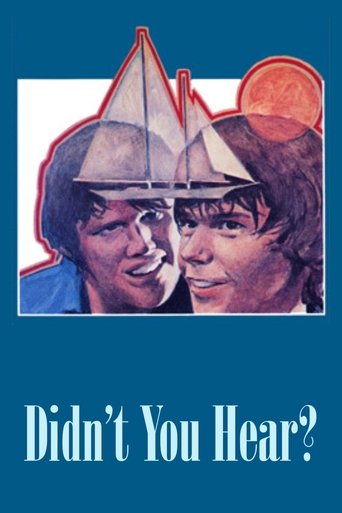
Didn’t You Hear? (1970)
Kevin is wandering through the confused haze that most college students pass through at one time or another: lectures that make little - if any - sense, pranks by the fraternities and sororities, deep yet meaningless discussions on philosophy with ones friends. Through all of this, Kevin passes in and out of a dream-like fantasy world, in which he and his friends sail the ship 'Queen of Sheba' to a variety of islands, with natives both friendly and hostile.
- Erscheinungsdatum
- 1970-12-16
- TMDB
- 7.0 / 10 (2)
- Laufzeit
- 1 Std. 32 Min.
- Genres
- Drama, Fantasy
- Regie
- Skip Sherwood
Besetzung
- Dennis Christopher — Kevin
- Cheryl Waters — Paige
- Gary Busey — James
- Tony Mumolo — Knight
- John Kauffman — Steve
- Terence O'Brien — Peter
- Jack Kosslyn — Higby
- Mike Mickler — Virgil
- John Rice — Crosley
- James Farren — Ian
- Scott McBreen — Jeff
- Judy Nagle — Judy
Wissenswertes
Didn't You Hear? is a 1970 independent psychedelic drama-fantasy film directed, co-written, and produced by Skip Sherwood. The film was co-written by Karl Krogstad, Joanne Tilton, and Mike Mickler—the latter of whom also co-starred in the film, alongside lead Dennis Christopher, Gary Busey, and Cheryl Waters, among others. Musician Mort Garson composed the film with all electronic music, primarily utilizing the Moog synthesizer. He also released an album with the same name.
Production
Pioneering musician Mort Garson released an album simultaneously with the film, which was the first to ever be scored entirely electronically. The title song (of both album and film), "Didn't You Hear? (feat. Tom Muncrief)" was released as a single with mild success. The film was also the first ever to feature the use of a Moog synthesizer.
The film was considered a lost film for some years. During its initial premiere in Seattle, Washington, there were several snowstorms which affected cinema attendance. After a mild showing, it re-premiered the following year in scattered other Washington cities. Skip Sherwood Productions, Inc. revived the film around 1983, and it began to develop a cult following, albeit growing stronger due to its inaccessibility.
There also exists an Italian version of this film, with Italian actors dubbing over the dialogue. It is unclear when that was released.
Auf Wikipedia weiterlesen · Text aus Wikipedia, CC BY-SA 4.0. Daten aus Wikidata.
Empfohlen
- The Shepherd 2023 · ★ 7.0
- How Sarah Got Her Wings 2015 · ★ 5.9
- Pinocchio 2009 · ★ 6.1
- Jonathan 2018 · ★ 5.9
- Northfork 2003 · ★ 6.0
- Paradise Hills - Flucht aus dem Wunderland 2019 · ★ 5.9
- Das Haus in der Carroll Street 1988 · ★ 6.0
- Tigertail 2020 · ★ 6.7
- I Am David 2003 · ★ 6.8
- Über Nacht Familienvorstand 2006 · ★ 6.1
- Hagen - Im Tal der Nibelungen 2024 · ★ 6.2
- The Parts You Lose 2019 · ★ 6.6