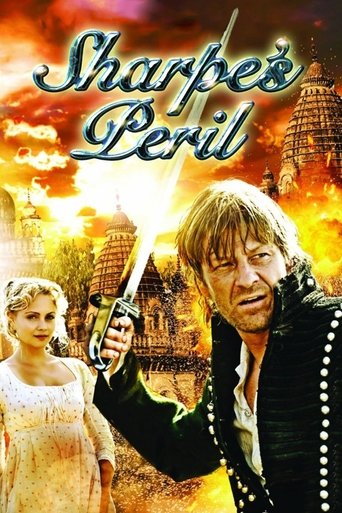
Sharpe's Peril (2008)
Our story begins at the end of Sharpe's Challenge. Sharpe and Harper are en route to Madras when they encounter a baggage train from the East India Company traveling through hostile territory. Chitu, a legendary bandit leader in control of the area, strikes fear in the members of the party. When an attack occurs Sharpe takes control of the situation, leading the group 300 miles through enemy territory and training the disorganized, rag-tag group to be proper soldiers. Despite all these responsibilities, Sharpe still manages to find time for a little romance...
- Date of release
- 2008-11-02
- TMDB
- 6.7 / 10 (25)
- Runtime
- 2h 17m
- Genres
- War, Adventure, Drama, History
- Director
- Tom Clegg
- Collection
- Sharpe Collection
Casting
- Sean Bean — Richard Sharpe
- Daragh O'Malley — Harper
- Michael Cochrane — Simmerson
- Velibor Topic — Dragomirov
- Beatrice Rosen — Marie Angelique
- Raza Jaffrey — Lance Naik Singh
- Steve Speirs — Wormwood
- Jonny Coyne — Croop (as Jonathan Coyne)
- Luke Ward-Wilkinson — Beauclere
- Nandana Sen
- Amit Behl
- Charles Venn
Interesting facts
Sharpe's Peril is a 2008 British TV film, and the 16th and final episode of the ITV series based on Bernard Cornwell's historical fiction novels about the English soldier Richard Sharpe during the Napoleonic Wars. Unlike most parts of the TV series, Sharpe's Peril and the preceding Sharpe's Challenge are not based on Cornwell's novels. Both are set in 1817, two years after Sharpe has retired as a farmer in Normandy, so chronologically they come after Sharpe's Assassin (1815) and before Sharpe's Devil (1820–1821). In Sharpe's Challenge and Sharpe's Peril, Sharpe and his comrade-in-arms, Patrick Harper, are called out of retirement and asked to go to India.
Production history
At a book signing in Bath on 11 October 2006, Bernard Cornwell revealed that there were plans by ITV to film two more episodes. When asked about the stories, Cornwell said that he believed that they were producing two new stories specially for television. Filming of Sharpe's Peril, produced by Celtic Film/Picture Palace/Duke Street Films, began on 3 March 2008 in India (in Orchha and Khajuraho), and finished in late April.
The film was created both as a 2 x 90 minute version (circa 2 x 69 minutes without adverts, i.e. 138 minutes in total) and a single 100 minute version.
Read on Wikipedia · Text from Wikipedia, CC BY-SA 4.0. Data from Wikidata.
Recommended
- Medieval 2022 · ★ 6.8
- Shout at the Devil 1976 · ★ 6.0
- Outlaws - For Greater Glory 2012 · ★ 7.0
- Jacknife 1989 · ★ 6.4
- The Last of the Mohicans 1992 · ★ 7.4
- Flyboys 2006 · ★ 6.5
- Field of Lost Shoes 2015 · ★ 6.1
- Napoleon 2023 · ★ 6.3
- Bat★21 1988 · ★ 6.3
- Force 10 from Navarone 1978 · ★ 6.3
- Behold a Pale Horse 1964 · ★ 6.0
- Walking with the Enemy 2014 · ★ 6.3