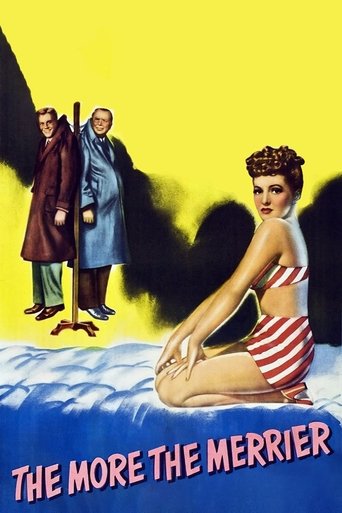
The More the Merrier (1943)
The only picture with a DINGLE!
It's World War II and there is a severe housing shortage everywhere - especially in Washington, D.C. where Connie Milligan rents an apartment. Believing it to be her patriotic duty, Connie offers to sublet half of her apartment, fully expecting a suitable female tenent. What she gets instead is mischievous, middle-aged Benjamin Dingle. Dingle talks her into subletting to him and then promptly sublets half of his half to young, irreverent Joe Carter - creating a situation tailor-made for comedy and romance.
- Date of release
- 1943-05-13
- TMDB
- 6.9 / 10 (105)
- Runtime
- 1h 44m
- Genres
- Comedy, Romance
- Director
- George Stevens
Casting
- Jean Arthur — Constance Milligan
- Joel McCrea — Joe Carter
- Charles Coburn — Benjamin Dingle
- Richard Gaines — Charles J. Pendergast
- Bruce Bennett — FBI Agent Evans
- Frank Sully — FBI Agent Pike
- Donald Douglas — FBI Agent Harding
- Clyde Fillmore — Senator Noonan
- Stanley Clements — Morton Rodakiewicz
- Sam Ash — Committee Member (uncredited)
- Don Barclay — Drunk (uncredited)
- Brandon Beach — Shaving Gag (uncredited)
Interesting facts
- Awards: 1 · Nominations: 6. Including: Academy Award for Best Supporting Actor
The More the Merrier is a 1943 American romantic comedy film produced and directed by George Stevens, and starring Jean Arthur, Joel McCrea, and Charles Coburn. The film's script—from Two's a Crowd, an original screenplay by Garson Kanin (uncredited)—was written by Robert Russell, Frank Ross, Richard Flournoy, and Lewis R. Foster. Set in Washington, D.C., the film presents a comic look at the housing shortage during World War II.
Production
Jean Arthur got the ball rolling on The More The Merrier, paying playwright and writer Garson Kanin $25,000 to adapt his short story "Two's a Crowd" into a screenplay. She hoped to take the role of Connie and serve out her contract with Columbia Studios, which had become irksome due to her deteriorating relationship with studio boss Harry Cohn. Kanin co-wrote the script with Robert Russell and Frank Ross, Arthur's husband.
Principal photography took place between September 11 and December 19, 1942, with additional "inserts" filmed in late January 1943.
Stevens, known as a perfectionist, filmed many takes of each scene and shot from multiple angles. McCrea recalled that studio boss Cohn approached him during production, saying, "What's that son of a bitch Stevens doing, making all that film? He used more exposed film in one picture than in any five pictures I've ever made."
Stevens was working under a three-film contract at Columbia Studios, and completed the terms of his contract with The More the Merrier. He had previously shot two Cary Grant vehicles at Columbia—the melodrama Penny Serenade (1941) and the comedy-drama The Talk of the Town (1942). Less than a month after finishing work on The More the Merrier, he traveled to North Africa with the Army's combat photography unit.
In early drafts, The More The Merrier was titled Two's a Crowd. Other titles considered included Washington Story; Full Steam Ahead; Come One, Come All; and Merry-Go-Round, which actually tested best with audiences. Washington officials, though, objected to a title and plot elements that suggested "frivolity on the part of Washington workers". The More the Merrier was finally approved as the title.
Read on Wikipedia · Text from Wikipedia, CC BY-SA 4.0. Data from Wikidata.
Recommended
- Yoh! Bestie 2026 · ★ 6.2
- Starting Over 1979 · ★ 6.4
- Someone Like You... 2001 · ★ 6.0
- No Hard Feelings 2023 · ★ 6.7
- Love, Weddings & Other Disasters 2020 · ★ 6.0
- Sex Appeal 2022 · ★ 6.6
- Girl on a Bicycle 2013 · ★ 5.9
- Let's Make Love 1960 · ★ 6.4
- Duplex 2003 · ★ 6.1
- What's Love Got to Do with It? 2023 · ★ 6.1
- ¿Quieres ser mi hijo? 2023 · ★ 8.4
- The Wrong Paris 2025 · ★ 6.7