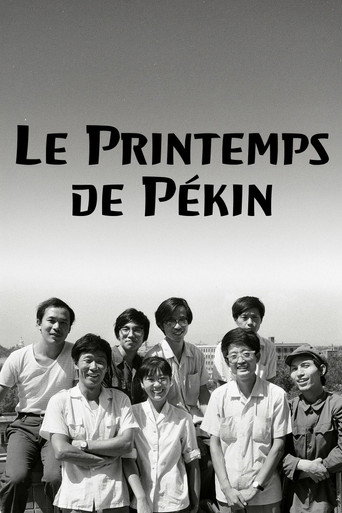
Le Printemps de Pékin (2021)
北京之春
Ce film documentaire retrace la brève période de liberté artistique et de mouvement démocratique qui a suivi la brutale révolution culturelle chinoise de 1978 à 1982.
- Date de sortie
- 2021-03-05
- TMDB
- 7.7 / 10 (3)
- Durée
- 1 h 40 min
- Genres
- Documentaire, Histoire
- Réalisateur
- Andy Cohen, Gaylen Ross
Anecdotes
Beijing Spring is a 2021 American documentary film directed by Andy Cohen and co-directed by Gaylen Ross. The film chronicles the struggle for free speech and free artistic expression in the People's Republic of China (PRC) during a brief period of political reform during the late 1970s known as the Beijing Spring. Production started in 2010 and finished in 2020. Due to legal and jurisdictional issues surrounding the rights of Chi Xiaoning's never-before-seen archival footage, production was halted for four years until Hong Kong's M+ Museum untangled complicated ownership rights.
Background
The Beijing Spring began with Mao Zedong's death in September 1976 and peaked with Deng Xiaoping's liberalization efforts in 1978-1979. Along with economic reforms, Deng loosened censorship, allowing western books and ideas into China, and experimented with free speech, allowing citizens to express their thoughts freely in one easily monitored locale: the Democracy Wall, a long brick wall running along Xidan Street near Tiananmen Square.
The film focuses on a group of artists called the Stars, which grew out of the underground magazine Today. At Democracy Wall, the artists pushed the limits of free speech by posting prohibited art forms such as abstraction and nudity, photos and poetry depicting everyday life, as well as sculpture critical of the CCP.
After being refused the right to officially exhibit their avant-garde work in a gallery, the Stars held an illegal exhibition on the fence outside the National Museum of China. It was immediately taken down by the police and the works confiscated.
Provoked and incensed, Deng cracked down on the Democracy Wall movement and Stars art group in 1980, closing the wall and issuing arrests, putting an end to the Beijing Spring. The government-sponsored Anti-Spiritual Pollution campaign that followed sought to curtail Western-inspired liberal ideas from "polluting" China's youth and culture.
For the first time ever, Beijing Spring shows 16-mm footage of the illegal 1979 Stars art exhibit hung on the iron fence of the National Museum, as well as modern China's first protest rally and march through the city streets. After being detained by the authorities for illegally filming the illegal protest, Chi Xiaoning tricked the authorities into believing he destroyed the footage by exposing a blank reel of film.
Lire sur Wikipédia · Texte de Wikipédia, CC BY-SA 4.0. Données de Wikidata.
Recommandés
- Making waves : la magie du son au cinéma 2019 · ★ 6.9
- David Bowie, les cinq dernières années 2017 · ★ 7.1
- Whitney 2018 · ★ 7.3
- Audrey Hepburn : douleur et gloire 2020 · ★ 7.1
- Bettie Page se dévoile 2013 · ★ 6.8
- Western Stars 2019 · ★ 7.0
- Marina Abramović: The Artist Is Present 2012 · ★ 7.3
- 11 septembre : dans la cellule de crise du Président 2021 · ★ 6.9
- Capitalism: A Love Story 2009 · ★ 7.1
- Frank et Ollie 1995 · ★ 7.4
- Wham! 2023 · ★ 7.3
- Justin Bieber's Believe 2013 · ★ 6.9