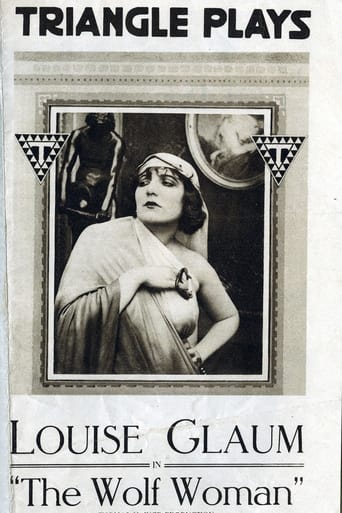
The Wolf Woman (1916)
An narcissistic woman with the ability to charm, Leila Aradella reaps delight from preying upon weak men. Her first victim is John Morton, a talented lawyer, whom she ruins both morally and financially. Her second victim, Rex Walden, the generous son of society matron Mrs. Walden, becomes her complete slave. Mrs. Walden sends her elder son Franklin to try to dissuade Leila from toying with Rex's affections. Franklin, however, also falls under Leila's spell, and Rex is driven to suicide by her callous behavior. Desperate, Mrs. Walden enlists Adele Harley, a girl of strong moral character, to fight Leila for Franklin's affections. Adele's determined victory causes Leila to lose her confidence, and in a drunken state, she cuts her own face with a shard from her shattered mirror. Permanently disfigured, Leila ends a broken and lonely woman.
- Data de estreia
- 1916-09-17
- TMDB
- 8.0 / 10 (1)
- Duração
- 50 min
- Géneros
- Drama
- Realizador
- Raymond B. West
Elenco
- Louise Glaum — Leila Aradella
- Charles Ray — Rex Walden
- Howard Hickman — John Morton
- Marjory Temple — Adele Harley
- Gertrude Claire — Mrs. Walden
- Wyndham Standing — Franklin Walden
Curiosidades
The Wolf Woman is a 1916 silent era drama motion picture starring Louise Glaum, Howard C. Hickman, and Charles Ray.
Production
The film attracted attention for the special effect of Glaum's character falling headlong through a large mirror. One newspaper reported on the effect as follows: "The effect is declared to be among the most sensational ever filmed, and for that reason the director and his camera man refuse to divulge their secret.
Newspaper advertisements for the film called Leila "a modern siren," a woman who "regards men as her rightful prey." The studio's advertising also touted C. Gardner Sullivan's script for its "daring disregard for the artificialities of conventional dramatic construction," noting that he "has no mercy on the 'Wolf Woman' and crowns her career of self glorification and malicious destruction with ruin and disfigurement."
Sullivan said that he intended Glaum's character to be "a living proof of the triumph of the flesh, in whose creed the lure of the physical was placed above moral, spiritual or mental worth, and in whose incense-laden apartments the idol of sensuality replaced the crucifix or family Bible."
Ler na Wikipédia · Texto da Wikipédia, CC BY-SA 4.0. Dados do Wikidata.
Recomendados
- A Grande Ilusão 2013 · ★ 6.0
- O Pagador de Promessas 1962 · ★ 8.1
- A Luta por um Ideal 2012 · ★ 6.2
- Lady Driver 2020 · ★ 6.4
- Each Dawn I Die 1939 · ★ 6.9
- O Processo Quiller 1966 · ★ 5.9
- Castelos de Gelo 2010 · ★ 6.3
- As Chaves do Reino 1944 · ★ 7.1
- Framed 1947 · ★ 6.5
- Omaha 2025 · ★ 6.9
- O Rio 1984 · ★ 6.4
- Eleanor the Great 2025 · ★ 6.8