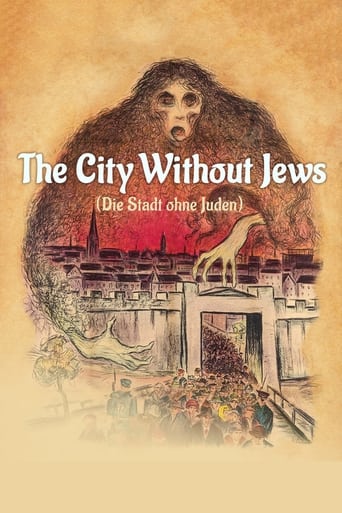
The City without Jews (1924)
Die Stadt ohne Juden
In the Republic of Utopia, because of the bad economic crisis ailing the nation, the Jews are made the scapegoats for the economic and social ills affecting the population; therefore, the government decides to expel them. Leo Strakosch is among the exiled. He is engaged to Counsellor's Linder's daughter. He gets into the Republic, in a clandestine way, to show to the society the wrongness of their anti-semitic prejudice. Bettauer's novel differs essentially from the film version. "Vienna" was named "Utopia." Even a happy ending was provided.
- Date of release
- 1924-07-25
- TMDB
- 6.5 / 10 (31)
- Runtime
- 1h 27m
- Genres
- Drama
- Director
- H.K. Breslauer
Casting
- Johannes Riemann — Leo Strakosch
- Hans Moser — Rat Bernart
- Karl Tema — Rat Linder
- Anny Miletty — Tochter Lotte
- Eugen Neufeld — Bundeskanzler
- Ferdinand Mayerhofer — Rat Volbert
- Mizi Griebl — seine Frau
- Hans Effenberger — Alois Carroni
- Gisela Werbisek — Köchin Kathi (as Gisela Werbezirk)
- Armin Berg — Kommiss Isidor
- Sigi Hofer — Moritz
- Armin Seydelmann — Oberhaupt der Staatskirche
Interesting facts
- Based on: The City Without Jews
The City Without Jews is a 1924 Austrian Expressionist film by Hans Karl Breslauer, based on the novel of the same title by Hugo Bettauer. The film is one of the few surviving Expressionist films from Austria and has therefore been well researched. The film was first shown on 25 July 1924 in Vienna.
Background
The film was made in 1924, about two years after the publication of Bettauer's novel. It differs from the book in several ways: for example, the city in the film is called "Utopia", instead of "Vienna". The film also has a conciliatory happy ending, which is not only the exact opposite of the message of the book, but also represents a change of direction within the film itself, which is thus revealed as the dream of an antisemite who at last come…
The film was Hans Moser's second cinematic role. The female lead was played, as so often in Breslauer's films, by Anny (or Anna) Milety, whom he later married (in 1925). The well-known Jewish actors Gisela Werbisek (billed as "Werbezirk") and Armin Berg appeared only in minor roles, as Kathi the cook and Isidor the commissionaire. The Expressionist backdrops and decor that characterise some scenes were the work of Julius von Borsody.
Other cast members were Eugen Neufeld (Bundeskanzler Dr. Schwerdtfeger), Karl Thema (Cllr. Linder), Ferdinand Mayerhofer (Cllr. Volbert), Mizzi Griebl (Volbert's wife) and Hans Effenberger (Alois Carroni).
Read on Wikipedia · Text from Wikipedia, CC BY-SA 4.0. Data from Wikidata.
Recommended
- Eleanor the Great 2025 · ★ 6.8
- Gentleman's Agreement 1947 · ★ 7.0
- This Crazy Heart 2017 · ★ 7.3
- Fast Girls 2012 · ★ 6.0
- Hungry Hearts 2015 · ★ 6.5
- Won't Back Down 2012 · ★ 6.2
- Omaha 2025 · ★ 6.9
- Stopped on Track 2011 · ★ 6.8
- School Ties 1992 · ★ 6.5
- Waiting for Anya 2020 · ★ 6.3
- When Hitler Stole Pink Rabbit 2019 · ★ 7.0
- Shattered Glass 2003 · ★ 7.0