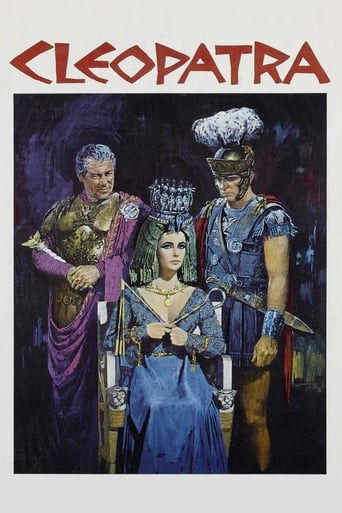
Cleopatra (1963)
The motion picture the world has been waiting for!
Determined to hold on to the throne, Cleopatra seduces the Roman emperor Julius Caesar. When Caesar is murdered, she redirects her attentions to his general, Marc Antony, who vows to take power—but Caesar’s successor has other plans.
- Date of release
- 1963-06-12
- TMDB
- 7.1 / 10 (904)
- Runtime
- 4h 11m
- Genres
- Drama, History, Romance
- Director
- Joseph L. Mankiewicz
Casting
- Elizabeth Taylor — Cleopatra
- Richard Burton — Marcus Antonius
- Rex Harrison — Julius Caesar
- Pamela Brown — High Priestess
- George Cole — Flavius
- Hume Cronyn — Sosigenes
- Cesare Danova — Apollodorus
- Kenneth Haigh — Brutus
- Andrew Keir — Agrippa
- Martin Landau — Rufio
- Roddy McDowall — Octavian - Caesar Augustus
- Robert Stephens — Germanicus
Interesting facts
- Box office: $57.8M
- Budget: $44M
- Earned 1.3× its budget
- Filmed in: Malibu and Almería Province
- Awards: 4 · Nominations: 9. Including: Academy Award for Best Cinematography, Color; Academy Award for Best Costume Design, Color; Academy Award for Best Art Direction, Color; Academy Award for Best Visual Effects
Cleopatra is a 1963 American epic historical drama film directed by Joseph L. Mankiewicz, who co-wrote the screenplay with Ranald MacDougall and Sidney Buchman, adapted from the 1957 book The Life and Times of Cleopatra by Carlo Maria Franzero, and from histories by Plutarch, Suetonius, and Appian. The film stars Elizabeth Taylor in the eponymous role, along with Richard Burton, Rex Harrison, Roddy McDowall and Martin Landau. It chronicles the struggles of the young queen Cleopatra VII of Egypt to resist the imperial ambitions of Rome.
Production
Walter Wanger had long desired to produce a biographical film about Cleopatra. As an undergraduate at Dartmouth College, he first read Théophile Gautier's 1838 story "One of Cleopatra's Nights" and then Thomas North's 1579 English translation of Plutarch's Lives and William Shakespeare's Antony and Cleopatra.
Around this time, Wanger had discovered through a private detective that his wife, Joan Bennett, was having an affair with her talent agent Jennings Lang. On the afternoon of December 13, 1951, Wanger shot Lang twice after having spotted him with Bennett in a parking lot near MCA. Lang survived, and Wanger, pleading insanity, served four months in prison at the Castaic Honor Farm, north of Los Angeles.
Wanger pitched the idea to various film studios, including Monogram and RKO Pictures. He also approached Taylor and her husband Michael Todd about producing the project with United Artists. Taylor expressed interest in the project but delegated the decision to Todd.
In the fall of 1958, Wanger's production company entered into a coproduction agreement with Twentieth Century Fox. Wanger pitched four properties—Cleopatra, Justine, The Dud Avocado, and The Fall—for the executives to consider. They selected the first three, and Cleopatra was the first to enter into production. On September 15, Wanger purchased the screen rights to Carlo Mario Franzero's biography The Life and Times of Cleopatra.
In December 1958, Ludi Claire, a writer and former actress, was hired to write a rough draft of the script. That same month, art director John DeCuir was hired to produce conceptual artwork to illustrate the visual scale of the project. In March 1959, English author Nigel Balchin was hired to write another script draft.
Read on Wikipedia · Text from Wikipedia, CC BY-SA 4.0. Data from Wikidata.
Recommended
- Cleopatra 1934 · ★ 6.1
- Mary 2024 · ★ 6.3
- Agora 2009 · ★ 7.0
- David and Bathsheba 1951 · ★ 5.8
- The Book of Daniel 2013 · ★ 7.0
- The Man from Elysian Fields 2001 · ★ 5.9
- The Bible: In the Beginning... 1966 · ★ 7.3
- Barabbas 1961 · ★ 6.9
- Alexander the Great 1956 · ★ 6.1
- Ben-Hur 1959 · ★ 7.9
- Demetrius and the Gladiators 1954 · ★ 6.6
- One Night with the King 2006 · ★ 6.7