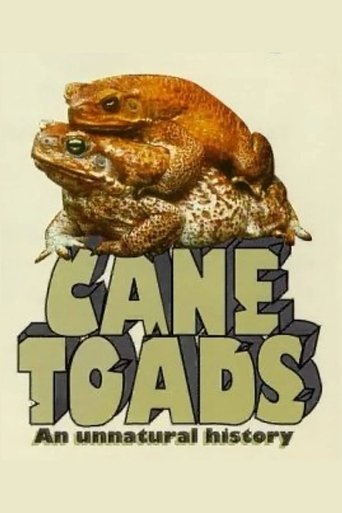
Cane Toads: An Unnatural History (1988)
The story of a bizarre biological blunder, warts and all!!
A documentary detailing the spread of Hawaiian sugar-cane toads through Australia in a botched effort to introduce them as counter pests.
- Date of release
- 1988-06-09
- TMDB
- 6.9 / 10 (41)
- Runtime
- 47m
- Genres
- Documentary
- Director
- Mark Lewis
Casting
- Tip Byrne — Self
- Glen Ingram — Self
- H.W. Kerr — Self
Interesting facts
Cane Toads: An Unnatural History is a 1988 documentary film about the introduction of cane toads to Australia. Cane toads were introduced to Australia with the aim of controlling a sugar cane pest, the cane beetle, but they over-multiplied and became a serious problem in the Australian ecosystem. It is often humorous, and is used in high schools and colleges as a complement to curricula in biology, ecology, environmental science, anthropology, geography, and communication. It was filmed in Cairns and Gordonvale in Queensland.
Production elements
One of the film's aesthetic and storytelling "innovations" was to try and tell much of the story from the cane toads' point of view. This was achieved by a number of extremely low angle shots. Lewis' goal was to give a voice to the toads who were at the center of so much controversy, and "create some sympathy for this animal that was so widely reviled".
Mark Lewis worked with director of photography Jim Frazier on Cane Toads because Frazier had constructed a set of lenses that were ideal for the project. Eventually, Panavision picked up the lenses and they became known as the Frazier lenses. For his interviews, Lewis used a mirror box to give the impression that the subjects were staring down the lens of the camera.
Lewis avoided harming toads and other wildlife during the production of the film. During a scene in which a man talks about intentionally running over toads with his car, footage appears to show a car swerving to hit toads. To simulate this, Lewis used potatoes which when shot at a distance appeared like toads on the road.
Read on Wikipedia · Text from Wikipedia, CC BY-SA 4.0. Data from Wikidata.
Recommended
- Explorer: The Last Tepui 2022 · ★ 7.5
- Shark Whisperer 2025 · ★ 6.7
- Cameraperson 2016 · ★ 6.7
- Ronaldo 2015 · ★ 7.0
- John Candy: I Like Me 2025 · ★ 7.9
- Predators 2025 · ★ 6.7
- Deliver Us from Evil 2006 · ★ 7.2
- Heart of a Dog 2015 · ★ 6.5
- Poisoned: The Dirty Truth About Your Food 2023 · ★ 7.0
- We Are Legion: The Story of the Hacktivists 2012 · ★ 7.1
- Marvel Studios Assembled: The Making of Hawkeye 2022 · ★ 7.2
- Samsara 2011 · ★ 8.1