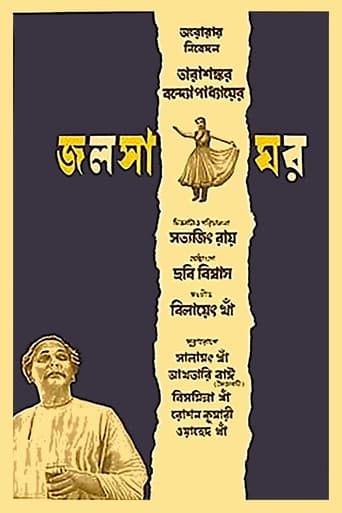
音乐室 (1958)
জলসাঘর
影片的主人公是一个生性嗜爱音乐的没落地主,名叫雷艾,居住在豪华的殿堂。他不想依靠自己的能力把土地经营好,只是坐吃山空,借一点祖上的积蓄苟延残喘,结果由于家业长期以来疏于管理,开始一步步败落下去。但雷艾却极喜铺张,不断举行花费巨大的音乐聆听聚会。影片中的马幸是新兴暴发户的代表,雷艾看不起他,这对新旧势力形成了残酷的交锋。两人都在举办音乐会上的排场上明争暗斗。在马幸眼里,对音乐的痴迷只是这位没落贵族维持荣誉的借口而已。因为雷艾即使不得不依靠变卖妻子的首饰来强撑台面,也要在众人面前维持住他品位的尊贵和典雅。甚至,为了赶在别人之前召开一场音乐会,他也不惜召回远在外地的妻儿,致使他们被突发的洪水夺去了生命。而雷艾认为自己是对音乐虔诚无比的信徒,为了表达他对神圣不可侵犯的音乐的向往和追求,付出了倾家荡家家破人亡的惨痛代价。没落的雷艾虚荣一如既往,在贫困潦倒时还要给马喂鹰嘴豆给大象配装饰,最后他把全家剩下的最后的一袋钱在众人面前赏给舞者之后,开始饮酒狂欢。之后,垂暮的他抛开拐杖,不顾他人拦阻飞身上马,疯狂地奔驰在自己的田地里,落马而死。 音乐室是萨耶吉特雷伊的第四部电影,尽管在他的作品中并不具有突出的代表性,但浸透了一种思想的力度与朴实的美感。音乐室的人物故事、场景时代虽然极其简约,但却深刻而清晰地勾画出角色灵魂深处的那种无可奈何的沧桑。没落贵族的代表雷艾,既是时代的寄生虫,又是古老文化的精灵,具有高贵而脆弱,痴迷而虚荣的双重特性。影片风格和缓凝重,透出一种特殊的钝态美和厚重气息。镜头的调度井然有序,顺畅而不事张扬,大巧若拙,具有返璞归真般的纯净。萨 雷伊这位享誉世界的电影大师,“印度新电影运动”中的中坚人物,并没有走实验的路子,也没有现代派电影的倾向,而是果断地回归到印度本土的文化,将民族的与世界的举重若轻地勾连起来,并依靠不懈努力将这一流派升华到了极致。音乐室便是这样一部极致之作。如果说印度新电影这一影像神话的缔造属于一个人群,那么萨雷伊无疑是这个人群中的高执火炬者。
演员阵容
- Chhabi Biswas — Biswambhar Roy
- Gangapada Basu — Mahim Ganguli
- Kali Sarkar — Anantha
- Tulsi Lahiri — Prashanna
- Padmadevi — Mahamaya Roy
- Pinaki Sengupta — Khoka Roy
- Begum Akhtar — Durga Bai
- Waheed Khan — Ustad Ujir Khan
- Roshan Kumari — Krishna Bai
- Sardar Akhtar — Singer
- Bismillah Khan — Musician
- Dakshinamohan Thakur — Musician
趣闻
- 获奖:2 · 提名:0. 包括:National Film Award for Second Best Feature Film; National Film Award for Best Bengali Feature Film
Jalsaghar is a 1958 Indian Bengali drama film written and directed by Satyajit Ray, based on a popular short story by Bengali writer Tarasankar Bandyopadhyay, and starring Chhabi Biswas. The fourth of Ray's feature films, it was filmed at Nimtita Raajbari in Nimtita, Murshidabad district.
Production
Jalsaghar was based on a popular short story written by Bengali writer Tarasankar Bandyopadhyay. After the box office failure of Aparajito (1956), Ray desperately needed a hit, and he decided to make a film that both was based on a popular piece of literature and would incorporate Indian music. It was his first film to extensively incorporate classical Indian music and dancing. Production on the film began in May 1957.
While in pre-production, Ray and his crew had difficulty finding a suitable location for Biswambhar Roy's palace. By chance, they met a man who recommended the palace of the Choudhurys in Nimtita, known as the Nimtita Rajbari, and Ray decided to scout the location.
According to Ray, "The Nimtita palace was perfect, except that the music room–it did have one, for Ganendra Narayan's uncle Upendra Narayan Choudhury had been a patron of music much like the nobleman in our story–was not impressive enough to serve as the setting for the sumptuous soirées that I had planned." Therefore, a more lavish music room was built at the Aurora Film Corporation studio in Maniktala, Kolkata.
Ray worked closely with composer Ustad Vilayat Khan on the film, although he was initially uncertain about the composer's musical choices, and had to convince Khan to compose more sombre pieces for the film.
在维基百科阅读更多 · 文本来自维基百科,CC BY-SA 4.0。数据来自 Wikidata。