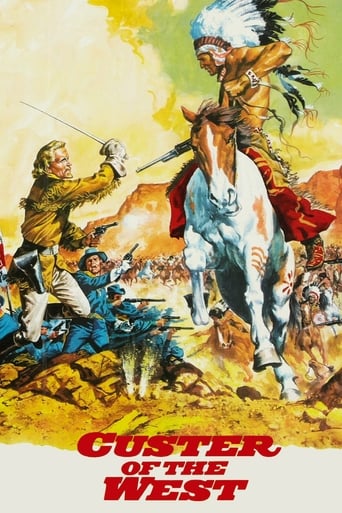
Custer of the West (1967)
From the fury and chaos of the Civil War to the glory days of the 7th Cavalry ...to the final earth-shaking charge at Little Big Horn!
The story of U.S. Army commander George Armstrong Custer, a flamboyant hero of the Civil War who later fought and was exterminated with his entire command by warring Sioux and Cheyenne tribes at the battle of Little Big Horn in 1876.
- Date of release
- 1967-11-09
- TMDB
- 5.9 / 10 (36)
- Runtime
- 2h 23m
- Genres
- History, Western, Drama
- Director
- Robert Siodmak
Casting
- Robert Shaw — General George Armstrong Custer
- Mary Ure — Elizabeth Custer
- Ty Hardin — Major Marcus Reno
- Jeffrey Hunter — Captain Benteen
- Lawrence Tierney — General Philip Sheridan
- Marc Lawrence — Gold Miner
- Kieron Moore — Chief Dull Knife
- Charles Stalmaker — Lieutenant Howells
- Robert Hall — Sergeant Buckley
- Jack Gaskins — Sergeant Gaskins
- Jack Taylor
- John Clark — Fort Doctor
Interesting facts
- Filmed in: Madrid
Custer of the West is a 1967 American epic Western film directed by Robert Siodmak that presents a highly fictionalized version of the life and death of George Armstrong Custer, starring Robert Shaw as Custer, Robert Ryan, Ty Hardin, Jeffrey Hunter, and Mary Ure. It is the first film production from Cinerama Releasing Corporation. The film was shot entirely in Spain.
Production
In the mid-1960s, 20th Century-Fox announced plans to produce a film about Custer, called The Day Custer Fell. It had been developed by producer David Weisbat and was to be written by Wendell Mayes. Fred Zinnemann was to direct, with Robert Shaw among the actors considered to play the title role. Mayes recalled, "One of the things that was going to be marvelous in it was: the battle occurred on June 25th, 1876 ...
Producer Philip Yordan decided to develop his own Custer film, and hired Bernard Gordon and Julian Zimet to write a script. According to Zimet, "The original brief was to turn out a typical Western sainted hero martyr script, which Gordon and I duly delivered. But Robert Shaw figured he would make it over to suit himself. Which he did. He turned Custer into a sadist of Shakespearean depth."
According to Bernard Gordon, "Production stumbled along on Custer as Julian and I tried to give the Indians a fair shake. Robert Shaw was helpful. A bright man and a fine writer, he approved of our point of view of that the Indians were victims right to the end. He even wrote one speech for Custer… that made this point sharply."
Yordan said he needed a known star (Shaw) and director (Siodmak) to raise the funds to produce the film.
Shaw took care of the battle scenes himself. Siodmak preferred directing ballroom scenes, which he had done so often in his long career they required no invention. What he didn't anticipate, as he choreographed fifty couples, was that the actor—whose intervention was designed to give coherence to the scene—would go crazy, punch him in the chops, and walk off the set.
Read on Wikipedia · Text from Wikipedia, CC BY-SA 4.0. Data from Wikidata.
Recommended
- News of the World 2020 · ★ 6.9
- Gods and Generals 2003 · ★ 6.4
- The Alamo 2004 · ★ 5.8
- Heaven's Gate 1980 · ★ 6.7
- Bury My Heart at Wounded Knee 2007 · ★ 6.5
- Dances with Wolves 1990 · ★ 7.8
- The Last of the Mohicans 1920 · ★ 6.4
- The Dead Don't Hurt 2024 · ★ 6.5
- The Birth of a Nation 1915 · ★ 5.9
- The Way West 1967 · ★ 6.1
- Geronimo: An American Legend 1993 · ★ 6.3
- Hombre 1967 · ★ 7.1