卡斯特将军 (1967)
Custer of the West
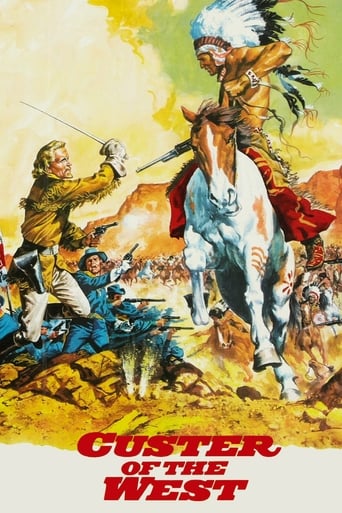
The story of U.S. Army commander George Armstrong Custer, a flamboyant hero of the Civil War who later fought and was exterminated with his entire command by warring Sioux and Cheyenne tribes at the battle of Little Big Horn in 1876.
- 上映日期
- 1967-11-09
- TMDB
- 5.9 / 10 (36)
- 片长(分钟)
- 2小时23分钟
- 类型
- 历史, 西部, 剧情
- 导演
- Robert Siodmak
演员阵容
- 罗伯特·阿奇博尔德·肖 — General George Armstrong Custer
- Mary Ure — Elizabeth Custer
- Ty Hardin — Major Marcus Reno
- Jeffrey Hunter — Captain Benteen
- 劳伦斯·蒂尔尼 — General Philip Sheridan
- 马克·劳伦斯 — Gold Miner
- Kieron Moore — Chief Dull Knife
- Charles Stalmaker — Lieutenant Howells
- Robert Hall — Sergeant Buckley
- Jack Gaskins — Sergeant Gaskins
- 杰克·泰勒
- John Clark — Fort Doctor
趣闻
- 拍摄地:马德里
Custer of the West is a 1967 American epic Western film directed by Robert Siodmak that presents a highly fictionalized version of the life and death of George Armstrong Custer, starring Robert Shaw as Custer, Robert Ryan, Ty Hardin, Jeffrey Hunter, and Mary Ure. It is the first film production from Cinerama Releasing Corporation. The film was shot entirely in Spain.
Production
In the mid-1960s, 20th Century-Fox announced plans to produce a film about Custer, called The Day Custer Fell. It had been developed by producer David Weisbat and was to be written by Wendell Mayes. Fred Zinnemann was to direct, with Robert Shaw among the actors considered to play the title role. Mayes recalled, "One of the things that was going to be marvelous in it was: the battle occurred on June 25th, 1876 ...
Producer Philip Yordan decided to develop his own Custer film, and hired Bernard Gordon and Julian Zimet to write a script. According to Zimet, "The original brief was to turn out a typical Western sainted hero martyr script, which Gordon and I duly delivered. But Robert Shaw figured he would make it over to suit himself. Which he did. He turned Custer into a sadist of Shakespearean depth."
According to Bernard Gordon, "Production stumbled along on Custer as Julian and I tried to give the Indians a fair shake. Robert Shaw was helpful. A bright man and a fine writer, he approved of our point of view of that the Indians were victims right to the end. He even wrote one speech for Custer… that made this point sharply."
Yordan said he needed a known star (Shaw) and director (Siodmak) to raise the funds to produce the film.
Shaw took care of the battle scenes himself. Siodmak preferred directing ballroom scenes, which he had done so often in his long career they required no invention. What he didn't anticipate, as he choreographed fifty couples, was that the actor—whose intervention was designed to give coherence to the scene—would go crazy, punch him in the chops, and walk off the set.
在维基百科阅读更多 · 文本来自维基百科,CC BY-SA 4.0。数据来自 Wikidata。