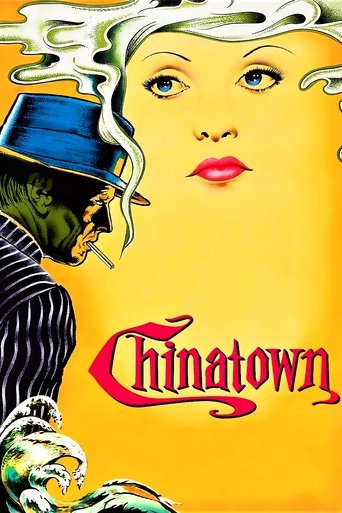
Chinatown (1974)
You get tough. You get tender. You get close to each other. Maybe you even get close to the truth.
Private eye Jake Gittes lives off of the murky moral climate of sunbaked, pre-World War II Southern California. Hired by a beautiful socialite to investigate her husband's extra-marital affair, Gittes is swept into a maelstrom of double dealings and deadly deceits, uncovering a web of personal and political scandals that come crashing together.
- Date of release
- 1974-06-20
- TMDB
- 7.9 / 10 (4510)
- Runtime
- 2h 10m
- Genres
- Crime, Mystery, Thriller
- Director
- Roman Polanski
- Collection
- The Jake Gittes Collection
Casting
- Jack Nicholson — J.J. 'Jake' Gittes
- Faye Dunaway — Evelyn Cross Mulwray
- John Huston — Noah Cross
- Perry Lopez — Lieutenant Lou Escobar
- Burt Young — Curly
- John Hillerman — Russ Yelburton
- Darrell Zwerling — Hollis I. Mulwray
- Roman Polanski — Man with Knife
- Diane Ladd — Ida Sessions
- Richard Bakalyan — Detective Loach
- Joe Mantell — Lawrence Walsh
- Roy Jenson — Claude Mulvihill
Interesting facts
- Box office: $29.2M
- Budget: $6M
- Earned 4.9× its budget
- Filmed in: Paramount Pictures Studios, Echo Park Lake, Santa Catalina Island, Los Angeles City Hall, Point Fermin Park, Stone Canyon Reservoir and 4 more
- Awards: 9 · Nominations: 13. Including: Academy Award for Best Writing, Original Screenplay; National Board of Review: Top Ten Films; BAFTA Award for Best Direction; BAFTA Award for Best Actor in a Leading Role
Chinatown is a 1974 American neo-noir mystery film directed by Roman Polanski and written by Robert Towne. It stars Jack Nicholson and Faye Dunaway, with supporting performances from John Huston, John Hillerman, Perry Lopez, Burt Young, Joe Mantell, Bruce Glover, James Hong and Diane Ladd. The film's story is inspired by the California water wars which were a series of disputes over Southern California water at the beginning of the 20th century that resulted in Los Angeles securing water rights in the Owens Valley. Produced by Robert Evans and distributed by Paramount Pictures, Chinatown was Polanski's final film made in the United States.
Production
In 1971, producer Robert Evans offered Towne $175,000 to write a screenplay for The Great Gatsby (1974), but Towne felt he could not better F. Scott Fitzgerald's novel. Instead, Towne asked Evans for $25,000 to write his own story, Chinatown, to which Evans agreed. Towne had originally hoped to also direct Chinatown, but realized that by taking Evans' money, he would lose control of the project's future and his role as a director.
Chinatown is set in 1937 and portrays the manipulation of a critical municipal resource—water—by a cadre of shadowy oligarchs. It was the first part of Towne's planned trilogy about the character J. J. Gittes, the foibles of the Los Angeles power structure, and the subjugation of public good by private greed. The second part, The Two Jakes, has Gittes caught up in another grab for a natural resource—oil—in the 1940s.
The character of Hollis Mulwray was inspired by and loosely based on Irish immigrant William Mulholland (1855–1935) according to Mulholland's granddaughter. Mulholland was the superintendent and chief engineer of the Los Angeles Department of Water and Power, who oversaw the construction of the aqueduct that carries water from the Owens Valley to Los Angeles.
Although the character of Hollis Mulwray was relatively minor in the film and he was killed in the early part of the movie, the events of Mulholland's life were portrayed through both the character of Mulwray and other figures in the movie.
Author Vincent Brook considers real-life Mulholland to be split, in the film, into "noble Water and Power chief Hollis Mulwray" and "mobster muscle Claude Mulvihill", just as Land syndicate and Combination members, who "exploited their insider knowledge" on account of "personal greed", are "condensed into the singular, and singularly monstrous, Noah Cross".
Read on Wikipedia · Text from Wikipedia, CC BY-SA 4.0. Data from Wikidata.
Recommended
- Basic Instinct 1992 · ★ 7.0
- Cape Fear 1991 · ★ 7.3
- Striking Distance 1993 · ★ 5.9
- Blue Velvet 1986 · ★ 7.6
- Blow Out 1981 · ★ 7.3
- Cleaner 2007 · ★ 6.1
- Strange Darling 2024 · ★ 6.9
- Body Double 1984 · ★ 6.7
- 8MM 1999 · ★ 6.5
- Tony Rome 1967 · ★ 6.4
- Righteous Kill 2008 · ★ 5.9
- Cutter's Way 1981 · ★ 6.5