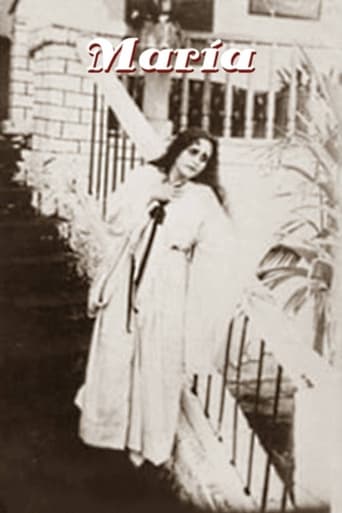
María (1922)
María tells the tragic love story of María, a beautiful young woman, and her half brother Efraín, a handsome young man from Valle del Cauca. They both fall in love and live their romance on the farm "El Paraíso", in Valle del Cauca, but not everything is rosy, since Efraín must go to Bogotá because of study reasons leaving María with pain in her soul. Some time later, María becomes ill and Emma tells her brother about the situation.
- Data lansării
- 1922-10-20
- TMDB
- 6.0 / 10 (2)
- Durată
- 3 h 0 min
- Genuri
- Dramă, Romantic
- Regizor
- Máximo Calvo Olmedo, Alfredo del Diestro
Distribuție
- Stella López Pommareda — María
- Hernando Sinisterra — Efraín
- Margarita López Pommareda — Emma
- Juan del Diestro — Efraín's Father
- Emma Roldán — Efraín's Mother
- Ernesto Ruiz — Young Efraín
- Jorge González — José
- Alfredo del Diestro — Salomón
- Ernesto Salcedo — Braulio
- Eduardo Salcedo — Carlos
Curiozități
María is a 1922 Colombian silent film in black and white, directed by Máximo Calvo Olmedo and Alfredo del Diestro.
Production
In the early 1900s, Colombia's economic boom favored the development of cinema, enabling many films to be imported and several movie theaters to be built, such as Bogotá's Gran Salón Olympia, inaugurated on December 8, 1912. The Italian Di Domenico brothers moved to Bogotá in 1909, before setting up the Sociedad Industrial Cinematográfica Latinoamericana (SICLA) in 1913.
For the screenplay, they chose to adapt Jorge Isaacs' only novel, María (published in 1867), which has become one of the most notable works of Romanticism in Spanish literature. Considered one of the masterpieces of Spanish-American literature, María tells several stories of impossible love, the characters belonging to different social classes or ethnic groups, notably that between Efraín and his cousin María.
Explanations differ as to the origins of the project.
According to most sources, the idea for the film came from Franciscan priest Antonio José Posada, a Colombian living in Panama at the time. A theater and film buff, he had seen several films by the Spaniard Máximo Calvo Olmedo, including Guerra entre Panamá y Costa Rica. In 1921, he suggested to Calvo, then in Panama, that he make a film based on the novel María by Jorge Isaacs.
Other sources suggest another hypothesis. According to two sources at the time, the idea was the brainchild of Alfredo del Diestro, who approached Francesco Di Domenico with a view to bringing it to fruition, but failed to reach an agreement.
Citește pe Wikipedia · Text din Wikipedia, CC BY-SA 4.0. Date din Wikidata.
Recomandate
- Secretul: Îndrăznește să visezi 2020 · ★ 7.4
- Dicționarul din Alcov 2003 · ★ 6.6
- Not Easily Broken 2009 · ★ 6.3
- Păcatul tău: Londra 2026 · ★ 7.4
- În secret 2014 · ★ 6.1
- Dot the I 2003 · ★ 6.0
- Iubește-mă, iubește-mă 2026 · ★ 6.1
- Northanger Abbey 2007 · ★ 6.8
- Peter Ibbetson 1935 · ★ 7.0
- Poveste de iarnă 2014 · ★ 6.3
- Pride and Prejudice 1940 · ★ 6.9
- Blind 2017 · ★ 6.1