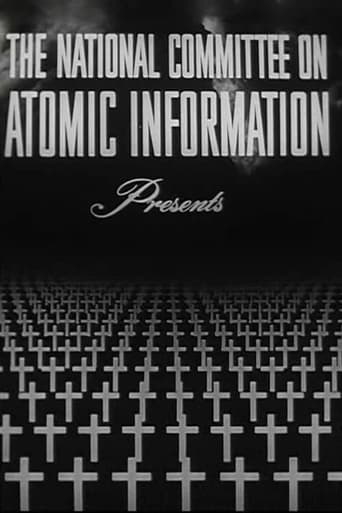
One World or None (1946)
This short traces the cooperation between nations that resulted in the development of atomic weapons, and how they were used to end World War II. It also makes the case for cooperation between nations in order that the further development of nuclear weapons will not spiral out of control and endanger the safety of the world.
- Date of release
- 1946-03-17
- Runtime
- 10m
- Genres
- Documentary, Animation
- Director
- Philip Ragan
Casting
- Hermann Göring — (archive footage)
- Raymond Gram Swing — Narrator
Interesting facts
- Based on: One World Or None
One World or None (1946) is an instructional documentary short film produced by the National Committee on Atomic Information in conjunction with Philip Ragan Productions. Made just months after the Atomic bombings of Hiroshima and Nagasaki, it is considered the first postwar "atomic scare" film.
Production
Ashley Montagu suggested making the film during a meeting of the Federation of American Scientists in 1945, and the idea was well-received. After writing the script and undergoing several revisions, the team sought the approval and advice of Albert Einstein.
When Montagu visited Einstein in June 1946, Einstein reviewed the script and responded positively, calling the title One World or None an excellent choice and declaring the script "just right" without suggesting any changes.
Einstein strongly supported the idea of using the film as a means of educating the public about the control of atomic energy. He saw the film as a step toward raising awareness of the need for international control over nuclear energy and believed that it required additional support and an extended educational campaign. The film was released in October 1946.
Technical assistance on One World or None was provided by the Federation of Atomic Scientists. Philip Ragan Productions was responsible for One World or None, using a mix of animation and live-action stock footage, including scenes from Hiroshima and the Nuremberg War Trials. Philip Ragan was a filmmaker from Philadelphia who specialized in cartoon animation.
Another connection to the NFB was composer Louis Applebaum, who composed approximately 250 film scores for the NFB between 1942 and 1960. He is also known for his work in Hollywood on Story of G.I. Joe (1945), Dreams That Money Can Buy (1947) and Lost Boundaries (1949).
Read on Wikipedia · Text from Wikipedia, CC BY-SA 4.0. Data from Wikidata.
Recommended
- Who Are You, Charlie Brown? 2021 · ★ 6.9
- Is the Man Who Is Tall Happy? 2013 · ★ 6.9
- Beyond Infinity: Buzz and the Journey to Lightyear 2022 · ★ 7.0
- Maternal Instinct 2026 · ★ 7.2
- The Soviet Story 2008 · ★ 7.3
- Fuck 2006 · ★ 6.4
- Daft Punk Unchained 2015 · ★ 7.2
- Selena Gomez: My Mind & Me 2022 · ★ 8.4
- Above Majestic 2018 · ★ 7.4
- Avatar: The Deep Dive - A Special Edition of 20/20 2022 · ★ 7.2
- Western Stars 2019 · ★ 7.0
- Daybreak Express 1957 · ★ 7.2