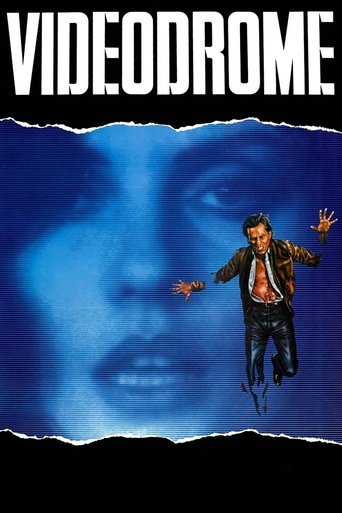
Videodrome (1983)
First it controls your mind. Then it destroys your body.
As the president of a trashy TV channel, Max Renn is desperate for new programming to attract viewers. When he happens upon "Videodrome," a TV show dedicated to gratuitous torture and punishment, Max sees a potential hit and broadcasts the show on his channel. However, after his girlfriend auditions for the show and never returns, Max investigates the truth behind Videodrome and discovers that the graphic violence may not be as fake as he thought.
- Date of release
- 1983-02-04
- TMDB
- 7.2 / 10 (2651)
- Runtime
- 1h 28m
- Genres
- Horror, Science Fiction, Mystery
- Director
- David Cronenberg
Casting
- James Woods — Max Renn
- Debbie Harry — Nicki Brand
- Sonja Smits — Bianca O'Blivion
- Peter Dvorsky — Harlan
- Leslie Carlson — Barry Convex
- Jack Creley — Brian O'Blivion
- Lynne Gorman — Masha
- Julie Khaner — Bridey
- Reiner Schwarz — Moses
- David Bolt — Raphael
- Lally Cadeau — Rena King
- Henry Gomez — Brolley
Interesting facts
- Box office: $2.1M
- Budget: $6M
- Earned 0.4× its budget
- Filmed in: Toronto
Videodrome is a 1983 Canadian science fiction body horror film written and directed by David Cronenberg and starring James Woods, Sonja Smits, and Debbie Harry. Set in Toronto during the early 1980s, it follows the CEO of a small UHF television station who stumbles upon a broadcast signal of snuff films. Layers of deception and mind-control conspiracy unfold as he attempts to uncover the signal's source, complicated by increasingly intense hallucinations that cause him to lose his grip on reality.
Production
The basis for Videodrome came from David Cronenberg's childhood. Cronenberg used to pick up American television signals from Buffalo, New York, late at night after Canadian stations had gone off the air, and worry he might see something disturbing not meant for public consumption. As Cronenberg explained, "I've always been interested in dark things and other people's fascinations with dark things.
Cronenberg's first exploration of themes of the branding of sex and violence and media impacting people's reality was writing a treatment titled Network of Blood in the early 1970s; its premise was a worker for an independent television company (who would become Max Renn in Videodrome) unintentionally finding, in the filmmaker's words, "a private television network subscribed to by strange, wealthy people who were willing to pay to see bizarre th…
Victor Solnicki, Dick Schouten, and Pierre David of Vision 4, a company taking advantage of Canada's tax shelter policies, aided Cronenberg in the film's financing. Vision 4 dissolved after Schouten's death and reorganized into Filmplan International which funded Scanners. Solnicki, David, and Claude Héroux formed Filmplan II which gave financial backing to Videodrome. This was the last film Cronenberg made under Canada's film tax shelter policy.
Cronenberg's increased reputation made it easier for his projects to get produced, leading to the film's $5.5 million budget, more interest from studios and producers, and a larger number of interested actors to choose from. After the box office success of Scanners, Cronenberg turned down the chance of directing Return of the Jedi, having had no desire to direct material produced by other filmmakers.
Cronenberg started writing the first draft of Videodrome in January 1981, and, as with first drafts of Cronenberg's prior projects, included many parts not featured in the final cut to make it more acceptable for audiences; this included Renn having an explosive grenade as a hand after he chops off his flesh gun during a hallucination, Renn and Nicki melting, via a kiss, into an object that then melts an on-looker, and five other characters besid…
Read on Wikipedia · Text from Wikipedia, CC BY-SA 4.0. Data from Wikidata.
Recommended
- The Den 2013 · ★ 6.1
- The Cell 2000 · ★ 6.3
- Eraserhead 1977 · ★ 7.3
- Saw 2004 · ★ 7.4
- Jigsaw 2017 · ★ 6.2
- Possessor 2020 · ★ 6.4
- Books of Blood 2020 · ★ 6.2
- The Taking of Deborah Logan 2014 · ★ 6.6
- The Resurrected 1991 · ★ 6.2
- Hardware 1990 · ★ 6.0
- Infinity Pool 2023 · ★ 6.0
- The Kindred 1987 · ★ 6.0