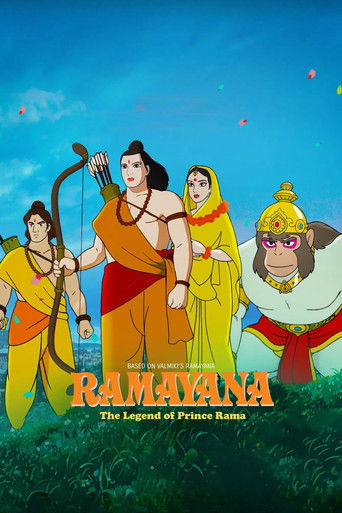
Ramayana, Shree Ram Katha (1997)
Ramayana: The Legend of Prince Rama
1992 Largometraje de animación tradicional indojaponés dirigido por Yugo Sako y Ram Mohan, producido por Sako y Krishna Shah y basado en la epopeya india Ramayana.
- Fecha de estreno
- 1997-11-03
- TMDB
- 8.3 / 10 (64)
- Duración
- 2 h 15 min
- Géneros
- Animación, Acción, Aventura, Fantasía
- Director
- Ram Mohan, Yûgô Sakô, 笹木幸一
Reparto
- Nikhil Kapoor — Rama (Voice)
- Raell Padamsee — Sita (Voice)
- Uday Mathan — Raavana (voice)
- Mishal Verma — Lakshman (voice) (English)
- Noel Godin — Hanuman (Voice) (English)
- Denzil Smith — Sugreeva (voice) (English)
- Rahul Bose — Bharatha (voice) (English)
- Bulbul Mukherjee — Dasharatha (voice) (English)
- Madhulika Varma — Kaikeyi (voice) (English)
- Pearl Padamsee — Manthara (voice) (English)
- Shagufta Jaffrey — Surpanakha (voice) (English)
- Easo Vivin Mathew — Indrajit (voice) (English)
Curiosidades
Ramayana: The Legend of Prince Rama is a 1993 Indo-Japanese anime film directed and produced by Yugo Sako, who co-directed the film with Koichi Sasaki and Ram Mohan. It is an adaptation of the Indian epic Ramayana. The film featured music composed by Vanraj Bhatia and was first released in India at the 24th International Film Festival of India. It was also screened at the 1993 Vancouver International Film Festival. Subsequently, a Hindi dubbed version was released in the late 1990s. On Jan 24, 2025, it was re-released in theatres in 4K with old English dub and new dubs in Hindi, Tamil and Telugu.
Production
In 1983, while working on "The Ramayana Relics" a documentary film about excavations by Dr. B. B. Lal near Allahabad in Uttar Pradesh, India, Yugo Sako came to know about the story of Ramayana. He liked the story of the Ramayana so much that he researched deeper into the topic and went on to read 10 versions of the Ramayana in Japanese.
The Indian Express published an article about Yugo Sako's "The Ramayana Relics" documentary on 25 April 1983. Soon thereafter, a protest letter based on the misunderstanding from the Vishva Hindu Parishad was received by the Japanese Embassy in Delhi, which said that no foreigners could arbitrarily cinematize Ramayana because it was the great national heritage of India.
With no choice and support left, the movie was decided to raise all production funds in Japan and to produce with artists from both nations. TEM Co., Ltd. financed the production and a new production studio Nippon Ramayana Film Co., Ltd. was set up and the principal animation of the film began in 1990 with 450 artists on board.
Leer en Wikipedia · Texto de Wikipedia, CC BY-SA 4.0. Datos de Wikidata.
Recomendadas
- Avatar Aang: El último maestro del aire 2026 · ★ 9.0
- El señor de los anillos: La guerra de los Rohirrim 2024 · ★ 6.5
- Bilal 2016 · ★ 6.8
- El rey mono 2023 · ★ 6.5
- Strings (Cuerdas) 2004 · ★ 6.6
- Simbad: La leyenda de los siete mares 2003 · ★ 7.1
- Hopper, el polloliebre 2022 · ★ 7.2
- Hilda y el Rey de la montaña 2021 · ★ 7.6
- Los Olchis 2021 · ★ 6.7
- El jinete del dragón 2020 · ★ 6.9
- Ninjago: Masters of Spinjitzu - Day of the Departed 2016 · ★ 7.8
- Wildwood: El Bosque Salvaje 2026 · ★ 8.5