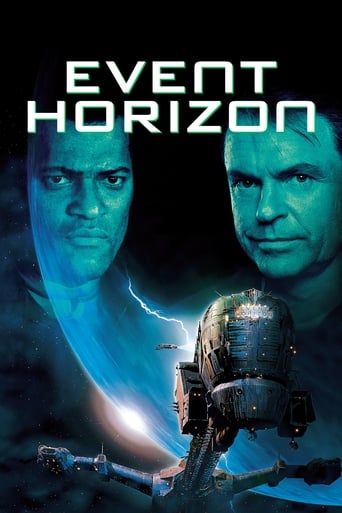
Event Horizon (1997)
Infinite space. Infinite terror.
In 2047, a group of astronauts are sent to investigate and salvage the starship Event Horizon which disappeared mysteriously seven years before on its maiden voyage. However, it soon becomes evident that something sinister resides in its corridors.
- Date of release
- 1997-08-15
- TMDB
- 6.6 / 10 (3564)
- Runtime
- 1h 36m
- Genres
- Horror, Science Fiction, Mystery
- Director
- Paul W. S. Anderson
Casting
- Laurence Fishburne — Miller
- Sam Neill — Weir
- Kathleen Quinlan — Peters
- Joely Richardson — Starck
- Richard T. Jones — Cooper
- Jack Noseworthy — Justin
- Jason Isaacs — D.J.
- Sean Pertwee — Smith
- Peter Marinker — Kilpack
- Holley Chant — Claire
- Barclay Wright — Denny
- Noah Huntley — Burning Man
Interesting facts
- Box office: $26.7M
- Budget: $60M
- Earned 0.4× its budget
- Filmed in: Pinewood Studios and England
- Awards: 1 · Nominations: 0
Event Horizon is a 1997 science fiction horror film directed by Paul Anderson and written by Philip Eisner. The film stars Laurence Fishburne, Sam Neill, Kathleen Quinlan, and Joely Richardson. Set in 2047, it follows the crew of the rescue vessel Lewis and Clark, led by Captain Miller (Fishburne), who are sent to investigate the Event Horizon, a spaceship that mysteriously vanished seven years prior during its maiden voyage to Proxima Centauri and has reappeared in orbit around Neptune. Accompanied by the ship's designer, Dr.
Production
Event Horizon was conceived in the early 1990s by aspiring screenwriter Philip Eisner. After rewatching Stanley Kubrick's The Shining (1980), he was inspired to transpose its haunted-house premise into a science-fiction setting. Eisner drew on his interest in physics, reasoning that exposure to warped spacetime at scales beyond normal human perception would psychologically shatter people. He has also cited the influence of H. P.
Eisner first pitched the concept verbally to his contract employers, producers Lawrence Gordon and Lloyd Levin, describing it as "a haunted house story in space". Gordon responded favourably and encouraged him to develop a full screenplay. Eisner began writing in spring 1992, spent eight months on the first draft and delivered the initial version of the script by October.
The opening thirty pages remained largely intact during production, except for a sequence involving the mining vessel the Lucky Strike, which was removed due to budget constraints. That sequence would have established the Lewis and Clark crew working as a team in action; some of its elements were instead moved later in the film to when the crew is on Event Horizon.
In Eisner's original screenplay for Event Horizon, there was no reference to heaven or hell. Instead, the crew of the Event Horizon was driven mad by experiencing warped space-time. Moreover, Eisner described the location they reached as a Lovecraftian alien environment featuring giant mollusk-like creatures in a sea of oil beneath a dead star; one of these alien minds had infected the ship.
After Mortal Kombat (1995) became a commercial success in the United States, English director Paul Anderson was inundated with screenplay offers and opportunities to direct the Mortal Kombat sequel Mortal Kombat Annihilation (1997) and the forthcoming X-Men (2000).
Read on Wikipedia · Text from Wikipedia, CC BY-SA 4.0. Data from Wikidata.
Recommended
- Iron Lung 2026 · ★ 6.8
- Prometheus 2012 · ★ 6.6
- Sphere 1998 · ★ 6.1
- The Thing 1982 · ★ 8.1
- Alien: Romulus 2024 · ★ 7.2
- Pandorum 2009 · ★ 6.6
- The Thing 2011 · ★ 6.3
- Life 2017 · ★ 6.5
- The Void 2016 · ★ 6.0
- Osiris 2025 · ★ 6.1
- Lifeforce 1985 · ★ 6.2
- Extinction 2015 · ★ 6.4