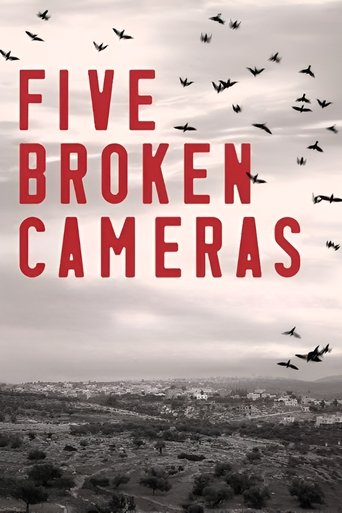
Five Broken Cameras (2011)
Five broken cameras – and each one has a powerful tale to tell. Embedded in the bullet-ridden remains of digital technology is the story of Emad Burnat, a farmer from the Palestinian village of Bil’in, which famously chose nonviolent resistance when the Israeli army encroached upon its land to make room for Jewish colonists. Emad buys his first camera in 2005 to document the birth of his fourth son, Gibreel. Over the course of the film, he becomes the peaceful archivist of an escalating struggle as olive trees are bulldozed, lives are lost, and a wall is built to segregate burgeoning Israeli settlements.
- Date of release
- 2011-11-23
- TMDB
- 7.5 / 10 (105)
- Runtime
- 1h 30m
- Genres
- War, Documentary
- Director
- Guy Davidi, Emad Burnat
Casting
- Emad Burnat — Himself (Narrator)
- Soraya Burnat — Herself (Emad's wife)
- Gibreel Burnat — Himself (Emad's 4th son)
- Mohammed Burnat — Himself (Emad's 1st son)
- Yasin Burnat — Himself (Emad's 2nd son)
- Taki-Ydin Burnat — Himself (Emad's 3rd son)
- Muhammad Burnat — Himself (Emad's Father)
- Intisar Burnat — Herself (Emad's mother)
- Bassem Abu-Rahma "Phil" — Himself (Emad's friend)
- Adeeb Abu-Rahma — Himself (Emad's friend)
- Ashraf Abu-Rahma "Daba" — Himself (Emad's friend)
- Eyad Burnat — Himself (Emad's brother)
Interesting facts
- Awards: 0 · Nominations: 1
5 Broken Cameras is a 2011 documentary film co-directed by Palestinian Emad Burnat and Israeli Guy Davidi. The film is a first-hand account of protests in Bil'in, a West Bank village affected by the Israeli West Bank barrier. The documentary was shot almost entirely by Palestinian farmer Emad Burnat, who bought his first camera in 2005 to record the birth of his youngest son. In 2009 Israeli co-director Guy Davidi joined the project. Structured around the destruction of Burnat's cameras, the filmmakers' collaboration follows one family's evolution over five years of turmoil.
Production
Israel began construction of an Israeli West Bank barrier in the West Bank village of Bil'in, Palestine in 2005. Discovering that the wall would cut through their agricultural land, confiscating half of it, the villagers initiated popular protests and were joined by Israeli and international activists. At that point Burnat received a camera to document the movement.
In 2007 the Israeli Supreme Court ordered the barrier rerouted, and four years later, after village access to some of the land was restored, the demonstrations were called off. A case against Canada, for failing to prevent Canadian corporations from being complicit in the building of the settlements, is currently pending before the UN Human Rights Committee.
The first year, Burnat filmed mainly to serve the purposes of activists. His footage was introduced as evidence in Israeli court and posted on YouTube to spread awareness of the growing movement.
As media interest in Bil'in grew, Burnat's footage gained international recognition and was used by local and international news agencies. He started working as a freelance photographer for Reuters and provided footage documenting the villagers' fight to professional filmmakers. This footage was used in such notable films as Shai Carmeli Pollac's Bil'in, My Love and Guy Davidi's and Alesandre Goetschmann's Interrupted Streams.
Burnat was approached in 2009 by Greenhouse, a Mediterranean film development project, to develop a documentary. The project focused on the non-violent movement and especially on Bassem Abu-Rahme, who was killed earlier that year at a demonstration in Bil'in.
Read on Wikipedia · Text from Wikipedia, CC BY-SA 4.0. Data from Wikidata.
Recommended
- Why We Fight: Prelude to War 1942 · ★ 6.5
- The Age of Stupid 2009 · ★ 6.6
- Avatar: The Deep Dive - A Special Edition of 20/20 2022 · ★ 7.2
- 2000 Meters to Andriivka 2025 · ★ 8.2
- Titanic: 20 Years Later with James Cameron 2017 · ★ 6.6
- Audrey 2020 · ★ 7.0
- Louis Theroux: The Settlers 2025 · ★ 8.4
- Love, Marilyn 2013 · ★ 6.5
- Making Waves: The Art of Cinematic Sound 2019 · ★ 6.9
- Naqoyqatsi 2002 · ★ 6.2
- Shipwrecked: Nightmare at Sea 2026 · ★ 7.1
- Marvel Studios Assembled: The Making of Hawkeye 2022 · ★ 7.2