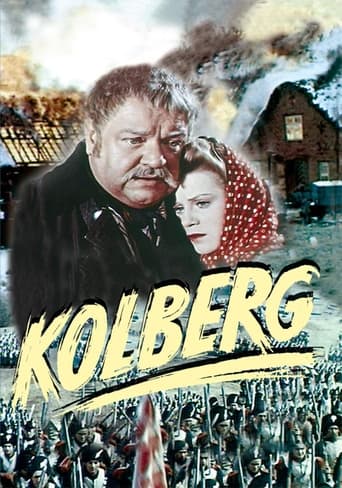
Kolberg (1945)
During Napoleon's victorious campaign in Germany, the city of Kolberg gets isolated from the retreating Prussian forces. The population of Kolberg refuses to capitulate and organizes the resistance against the French army, which immediately submits the city to massive bombardments.
- Date of release
- 1945-01-30
- TMDB
- 6.1 / 10 (12)
- Runtime
- 1h 50m
- Genres
- War, History, Drama
- Director
- Veit Harlan
Casting
- Heinrich George — Nettelbeck
- Kristina Söderbaum — Maria
- Horst Caspar — Gneisenau
- Gustav Diessl — Schill
- Paul Wegener — Loucadou
- Claus Clausen — König Friedrich Wilhelm III.
- Irene von Meyendorff — Königin
- Paul Bildt — Rektor
- Kurt Meisel — Claus Werner
- Franz Schafheitlin — Fanselow
- Paul Henckels — Major in Königsberg
- Otto Wernicke — Bauer Werner
Interesting facts
- Awards: 1 · Nominations: 0. Including: Film of the Nation
Kolberg is a 1945 Nazi propaganda historical film written and directed by Veit Harlan. One of the last films of the Third Reich, it was intended to bolster the will of the German population to resist the Allies.
Production
Joseph Goebbels began planning for Kolberg in 1941, and the film entered production in 1943. He hired Veit Harlan, the director of Jud Süß, to make the film on 1 June 1943. It was made in Agfacolor and cost 7.6 million ℛ︁ℳ︁, not 8.5 million ℛ︁ℳ︁ as is often stated.
Principal cinematography took place from 22 October 1943 to August 1944. The exteriors were shot in and around the cities of Kolberg, Königsberg, Treptow, Berlin, Seeburg, and Neustettin. Harlan said that the "law of madness" applied during the film's production, and that Adolf Hitler and Goebbels believed the film "could be more useful to them than even a military miracle, because they no longer believed in victory in any rational way".
Kristina Söderbaum, the director's wife, was cast as Maria, a farmer's daughter and one of the lead roles in the film.
Harlan claimed that 10,000 uniforms were made for the film, and that 6,000 horses and 187,000 soldiers were used for it. Harlan stated that he was given 4,000 sailors for a scene of a French attack across flooded fields after appealing the Kriegsmarine's rejection of his demand. The film's extras amounted to perhaps 5,000 soldiers; hundreds of Kolberg people participated for a daily fee of 5 ℛ︁ℳ︁.
Goebbels sent a memorandum from script supervisor Hans Hinkel requesting changes on 6 December 1944. These demands included the cutting of "all the mass battle and street scenes" in favor of "scenes featuring the familiar characters", a scene of a woman giving birth, and "the hysterical outburst of the brother Klaus". One-fourth of the film's budget was spent on scenes cut by Goebbels.
Read on Wikipedia · Text from Wikipedia, CC BY-SA 4.0. Data from Wikidata.
Recommended
- Rommel 2012 · ★ 6.0
- Ike: Countdown to D-Day 2004 · ★ 6.5
- Men in War 1957 · ★ 6.6
- Sometimes in April 2005 · ★ 7.1
- Seal Team Eight: Behind Enemy Lines 2014 · ★ 6.1
- Casualties of War 1989 · ★ 7.2
- Escape from Sobibor 1987 · ★ 7.2
- Stop-Loss 2008 · ★ 6.1
- The Devil's Double 2011 · ★ 6.7
- Triumph of the Spirit 1989 · ★ 6.5
- Fanny Lye Deliver'd 2019 · ★ 6.3
- Into the Storm 2009 · ★ 6.4