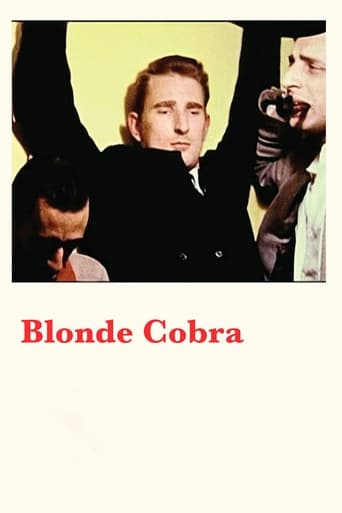
Blonde Cobra (1963)
Un hombre toquetea objetos, se mira en el espejo, se viste con distintas ropas, hace muecas a la cámara. Mientras, su voz narra momentos de desesperación, cita sentencias filosóficas y canciones infantiles y cuenta las historias de un niño solitario y una mujer que desea abandonarse a la perversión.
- Fecha de estreno
- 1963-04-08
- TMDB
- 3.0 / 10 (42)
- Duración
- 33 min
- Director
- Ken Jacobs
Reparto
- Ken Jacobs
- Jack Smith — Madame Nescience
Curiosidades
Blonde Cobra is a 1963 short film directed by experimental filmmaker Ken Jacobs. Footage for the film was shot by Bob Flieshner. The film is meant to be accompanied by the presence of a live radio during the screening. The film's title was derived from two of Jack Smith's favorite movies, Blonde Venus and Cobra Woman.
Background and production
Ken Jacobs made the film out of the surviving footage of two parodies of Hollywood movies shot in the late 1950s that had been abandoned by his friends Bob Fleischner and Jack Smith. The film borrows from various artistic influences, including: the "disruptive techniques" of Bertolt Brecht; John Cage's "embrace of chance operations and indeterminacy"; and Marcel Duchamp's transformation of everyday objects into art.
Jacobs also drafted a set of instructions that were distributed with the film, stipulating that, at specific moments during the film's broadcast, the soundtrack was to be interrupted by a live radio broadcast, to supplement the film's soundtrack. The film projectionist would be prompted by a visual signal shortly after the film began, "to dial in scratches of mostly talk, any kind".
Leer en Wikipedia · Texto de Wikipedia, CC BY-SA 4.0. Datos de Wikidata.
Recomendadas
- Avatar: La creación del mundo de Pandora 2010 · ★ 6.5
- ¡Venga alegría! 1923 · ★ 6.5
- Struggle: The Life and Lost Art of Szukalski 2018 · ★ 7.5
- En la sopa 1992 · ★ 6.8
- Dog Star Man 1965 · ★ 6.4
- Harmontown 2014 · ★ 6.6
- An Evening with Kevin Smith 2002 · ★ 7.4
- El experimento 2010 · ★ 6.4
- I Am Heath Ledger 2017 · ★ 7.4
- Jim Jefferies: Bare 2014 · ★ 7.6
- La llamada del Cristal: Así se hizo Cristal Oscuro: La era de la resistencia 2019 · ★ 7.5
- Joker: Put on a Happy Face 2020 · ★ 7.9