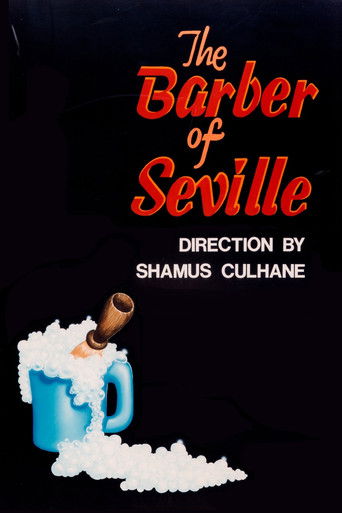
The Barber of Seville (1944)
Woody is standing outside the Seville Barber Shop looking at the ads. Wanting a "victory haircut", he decides to enter the shop only to find the owner has stepped out for a physical. Woody decides to cut his own hair ("I cut my own teeth") but unfortunately is mistaken for the owner when two other customers enter, one an Indian who wants a quick shampoo and the other, a construction worker who wants "the whole works" and, unfortunately, gets it.
- Date of release
- 1944-04-21
- TMDB
- 6.4 / 10 (56)
- Runtime
- 7m
- Genres
- Animation, Comedy
- Director
- Shamus Culhane
Casting
- Mel Blanc — Woody Woodpecker (voice)
- Ben Hardaway — Woody Woodpecker (voice)
- Kent Rogers — Woody Woodpecker (voice)
Interesting facts
- Based on: The Barber of Seville
The Barber of Seville is the tenth animated cartoon short subject in the Woody Woodpecker series. Released theatrically on April 22, 1944, the film was produced by Walter Lantz Productions and distributed by Universal Pictures.
Production notes
The Barber of Seville was the first cartoon to feature a new character design for Woody Woodpecker, by art director Art Heinemann.
In tandem with the use of the new Woody design, The Barber of Seville was the first Woody Woodpecker cartoon to use the standardized opening title card, animated by Hawkins, featuring Woody popping out of a log, asking Guess Who?!, and delivering his trademark laugh. The audio for this opening sequence is lifted from Woody's first starring appearance in the 1941 cartoon Woody Woodpecker, in which Woody was voiced by Mel Blanc.
Ben Hardaway, also the co-storyman on Barber of Seville, provided Woody's voice for the first time, succeeding Dick Nelson and Kent Rogers (the former only voiced Woody in the previous short Ration Bored, while the latter was killed in a World War II plane crash three months after The Barber of Seville's release), and Lee Sweetland performed as Woody's singing voice.
The Barber of Seville was the first Woody cartoon directed by veteran animator James "Shamus" Culhane, who had been working on Lantz's Swing Symphonies for a year prior, and would continue to direct entries in the series until 1946.
A parody of Gioachino Rossini's 1816 opera of the same name, The Barber of Seville is noted for its uses of speed, timing, and music synchronization. During the shaving of the second client, several shots are presented in rapid succession, some lasting only one-fourth of a second.
Read on Wikipedia · Text from Wikipedia, CC BY-SA 4.0. Data from Wikidata.
Recommended
- Playful Pluto 1934 · ★ 6.3
- The Big Bad Wolf 1934 · ★ 6.5
- Mickey and the Seal 1948 · ★ 6.8
- The Dover Boys at Pimento University or The Rivals of Roquefort Hall 1942 · ★ 6.8
- Thru the Mirror 1936 · ★ 7.2
- Out on a Limb 1950 · ★ 6.9
- Ye Olden Days 1933 · ★ 6.4
- Beach Picnic 1939 · ★ 6.1
- A Knight for a Day 1946 · ★ 6.6
- Moving Day 1936 · ★ 6.4
- Chip an' Dale 1947 · ★ 6.7
- Donald's Lucky Day 1939 · ★ 6.4