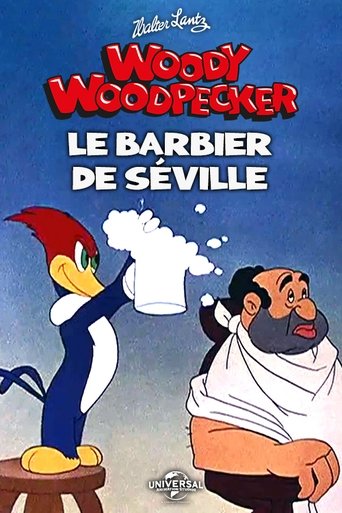
Le Barbier De Seville (1944)
The Barber of Seville
Woody est debout devant le salon de coiffure de Séville en train de regarder les annonces. Voulant une "coupe de cheveux de victoire", il décide d’entrer dans la boutique seulement pour constater que le propriétaire est sorti pour un examen physique. Woody décide de se couper les cheveux ("je me coupe les dents") mais malheureusement il est confondu avec le propriétaire quand deux autres clients entrent, un indien qui veut un shampooing rapide et l’autre, un ouvrier qui veut "tout le travail" et, malheureusement, l’obtient.
- Date de sortie
- 1944-04-21
- TMDB
- 6.4 / 10 (56)
- Durée
- 7 min
- Genres
- Animation, Comédie
- Réalisateur
- Shamus Culhane
Distribution
- Mel Blanc — Woody Woodpecker (voice)
- Ben Hardaway — Woody Woodpecker (voice)
- Kent Rogers — Woody Woodpecker (voice)
Anecdotes
- Adapté de : Le Barbier de Séville
The Barber of Seville is the tenth animated cartoon short subject in the Woody Woodpecker series. Released theatrically on April 22, 1944, the film was produced by Walter Lantz Productions and distributed by Universal Pictures.
Production notes
The Barber of Seville was the first cartoon to feature a new character design for Woody Woodpecker, by art director Art Heinemann.
In tandem with the use of the new Woody design, The Barber of Seville was the first Woody Woodpecker cartoon to use the standardized opening title card, animated by Hawkins, featuring Woody popping out of a log, asking Guess Who?!, and delivering his trademark laugh. The audio for this opening sequence is lifted from Woody's first starring appearance in the 1941 cartoon Woody Woodpecker, in which Woody was voiced by Mel Blanc.
Ben Hardaway, also the co-storyman on Barber of Seville, provided Woody's voice for the first time, succeeding Dick Nelson and Kent Rogers (the former only voiced Woody in the previous short Ration Bored, while the latter was killed in a World War II plane crash three months after The Barber of Seville's release), and Lee Sweetland performed as Woody's singing voice.
The Barber of Seville was the first Woody cartoon directed by veteran animator James "Shamus" Culhane, who had been working on Lantz's Swing Symphonies for a year prior, and would continue to direct entries in the series until 1946.
A parody of Gioachino Rossini's 1816 opera of the same name, The Barber of Seville is noted for its uses of speed, timing, and music synchronization. During the shaving of the second client, several shots are presented in rapid succession, some lasting only one-fourth of a second.
Lire sur Wikipédia · Texte de Wikipédia, CC BY-SA 4.0. Données de Wikidata.
Recommandés
- Pluto jongleur 1934 · ★ 6.3
- Le Grand Méchant Loup 1934 · ★ 6.5
- Mickey et le Phoque 1948 · ★ 6.8
- Les tartempions à l'université 1942 · ★ 6.8
- De l'autre côté du miroir 1936 · ★ 7.2
- Donald Blagueur 1950 · ★ 6.9
- Mickey au Moyen Âge 1933 · ★ 6.4
- Pique-Nique sur la Plage 1939 · ★ 6.1
- Chevalier d'un Jour 1946 · ★ 6.6
- Le Déménagement de Mickey 1936 · ★ 6.4
- Tic et Tac 1947 · ★ 6.7
- Donald le Chanceux 1939 · ★ 6.4