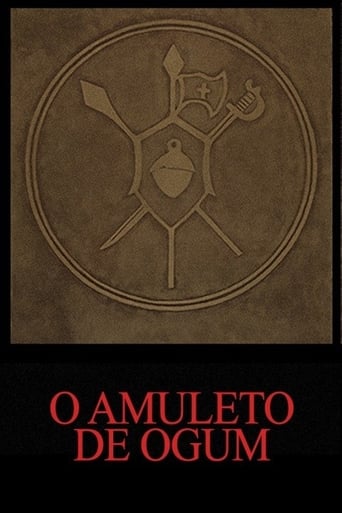
O Amuleto de Ogum (1974)
An ubiquitous folk singer narrates the tale of a young boy, who apparently becomes immune to gunfire after his mother arranges for him to have an amulet bearing Ogum's blessings. As time goes by, he becomes a valuable member of a mobster's hit-team, but ends up joining a group of people who resist his original employers.
- Erscheinungsdatum
- 1974-05-21
- TMDB
- 6.4 / 10 (11)
- Laufzeit
- 1 Std. 52 Min.
- Genres
- Fantasy, Krimi, Drama, Action
- Regie
- Nelson Pereira dos Santos
Besetzung
- Jofre Soares — Dr. Severiano
- Anecy Rocha — Eneida
- Ney Santanna — Gabriel
- Maria Ribeiro — Maria
- Emmanuel Cavalcanti — Dr. Barauna
- José Marinho — Quati
- Antonio Carnera — Zé índio
- Francisco Santos — Chico
- Erley José — Pai Erley
- Washington Fernandes — Pai Gogô
- Jards Macalé — Cego Firmino
- Luiz Carlos Lacerda — Madame Moustache
Wissenswertes
- Auszeichnungen: 0 · Nominierungen: 1
The Amulet of Ogum is a 1974 Brazilian drama film directed and co-written by Nelson Pereira dos Santos. The film, which depicts the life of a young man protected by the rites of umbanda, was shown at international film festivals following its release. It was selected as the Brazilian entry for the Best Foreign Language Film at the 48th Academy Awards, but was not nominated.
Production
After Nelson Pereira dos Santos's return to Brazil in 1973 and the ascendancy of Ernesto Geisel as dictator in 1974, gradual political liberalization led Santos to pursue projects like The Amulet of Ogum. The film was co-produced with the Brazilian state enterprise Embrafilme, based on an earlier script titled O amuleto da morte by Francisco Santos which was heavily rewritten by dos Santos to blend religious elements with the criminal storyline.
The character of Gabriel is deliberately personified as an aspect of Ogum, warrior god of metalworking. Local umbanda pai-de-santo José de Carvalho was consulted on the film's religious aspects, and filming was delayed for a week while appropriate permissions were acquired to film the ritual closing of Gabriel's body. Dos Santos acknowledged the influence of his first wife Laurita, an anthropologist, on the film's treatment of popular religion.
At the time of the film's production, the public practice of umbanda, candomblé, and macumba were legally regulated by the military dictatorship in Brazil. However, government censors only required one of the more graphic torture scenes to be cut before allowing the film's release in 1975.
Auf Wikipedia weiterlesen · Text aus Wikipedia, CC BY-SA 4.0. Daten aus Wikidata.
Empfohlen
- Gangster's Paradise: Jerusalema 2008 · ★ 6.6
- Pakt der Rache 2011 · ★ 5.9
- The Last Days of American Crime 2020 · ★ 6.4
- Imperium - Zwei Welten prallen aufeinander 2002 · ★ 6.2
- Walking Tall: The Payback 2007 · ★ 5.9
- State Property 2002 · ★ 6.4
- Convict 2014 · ★ 6.5
- Eine perfekte Waffe 1991 · ★ 6.4
- Die Grissom Bande 1971 · ★ 6.7
- Aufruhr in Santa Sierra 1950 · ★ 6.5
- The Shepherd 2023 · ★ 7.0
- Fast Charlie 2023 · ★ 6.3