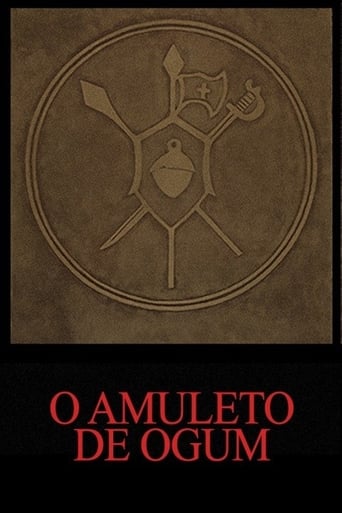
O Amuleto de Ogum (1974)
An ubiquitous folk singer narrates the tale of a young boy, who apparently becomes immune to gunfire after his mother arranges for him to have an amulet bearing Ogum's blessings. As time goes by, he becomes a valuable member of a mobster's hit-team, but ends up joining a group of people who resist his original employers.
- Fecha de estreno
- 1974-05-21
- TMDB
- 6.4 / 10 (11)
- Duración
- 1 h 52 min
- Géneros
- Fantasía, Crimen, Drama, Acción
- Director
- Nelson Pereira dos Santos
Reparto
- Jofre Soares — Dr. Severiano
- Anecy Rocha — Eneida
- Ney Santanna — Gabriel
- Maria Ribeiro — Maria
- Emmanuel Cavalcanti — Dr. Barauna
- José Marinho — Quati
- Antonio Carnera — Zé índio
- Francisco Santos — Chico
- Erley José — Pai Erley
- Washington Fernandes — Pai Gogô
- Jards Macalé — Cego Firmino
- Luiz Carlos Lacerda — Madame Moustache
Curiosidades
- Premios: 0 · Nominaciones: 1
The Amulet of Ogum is a 1974 Brazilian drama film directed and co-written by Nelson Pereira dos Santos. The film, which depicts the life of a young man protected by the rites of umbanda, was shown at international film festivals following its release. It was selected as the Brazilian entry for the Best Foreign Language Film at the 48th Academy Awards, but was not nominated.
Production
After Nelson Pereira dos Santos's return to Brazil in 1973 and the ascendancy of Ernesto Geisel as dictator in 1974, gradual political liberalization led Santos to pursue projects like The Amulet of Ogum. The film was co-produced with the Brazilian state enterprise Embrafilme, based on an earlier script titled O amuleto da morte by Francisco Santos which was heavily rewritten by dos Santos to blend religious elements with the criminal storyline.
The character of Gabriel is deliberately personified as an aspect of Ogum, warrior god of metalworking. Local umbanda pai-de-santo José de Carvalho was consulted on the film's religious aspects, and filming was delayed for a week while appropriate permissions were acquired to film the ritual closing of Gabriel's body. Dos Santos acknowledged the influence of his first wife Laurita, an anthropologist, on the film's treatment of popular religion.
At the time of the film's production, the public practice of umbanda, candomblé, and macumba were legally regulated by the military dictatorship in Brazil. However, government censors only required one of the more graphic torture scenes to be cut before allowing the film's release in 1975.
Leer en Wikipedia · Texto de Wikipedia, CC BY-SA 4.0. Datos de Wikidata.
Recomendadas
- Gangster's Paradise: Jerusalema 2008 · ★ 6.6
- Propiedad Estatal 2002 · ★ 6.4
- El pacto 2011 · ★ 5.9
- Los últimos días del crimen 2020 · ★ 6.4
- Empire 2002 · ★ 6.2
- Pisando fuerte 2 2007 · ★ 5.9
- Redentor 2014 · ★ 6.2
- Convict 2014 · ★ 6.5
- El guía 2023 · ★ 7.0
- La banda de los Grissom 1971 · ★ 6.7
- Fast Charlie 2023 · ★ 6.3
- Shade: Juego de asesinos 2003 · ★ 6.1