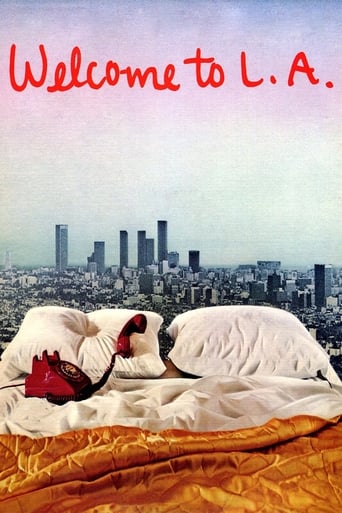
Welcome to L.A. (1976)
The City of the One Night Stands.
The lives of a group of Hollywood neurotics intersect over the Christmas holidays. Foremost among them, a songwriter visits Los Angeles to work on a singer's album. The gig, unbeknownst to him, is being bankrolled by his estranged father, a dairy magnate, who hopes to reunite with his son. When the songwriter meets an eccentric housewife who fancies herself a modern-day Garbo, his world of illusions comes crashing down.
- Date of release
- 1976-11-12
- TMDB
- 5.0 / 10 (24)
- Runtime
- 1h 46m
- Genres
- Romance, Drama, Music
- Director
- Alan Rudolph
Casting
- Keith Carradine — Carroll Barber
- Sally Kellerman — Ann Goode
- Geraldine Chaplin — Karen Hood
- Harvey Keitel — Ken Hood
- Lauren Hutton — Nona Bruce
- Viveca Lindfors — Susan Moore
- Sissy Spacek — Linda Murray
- Richard Baskin — Eric Wood
- Denver Pyle — Carl Barber
- John Considine — Jack Goode
- Allan F. Nicholls — David Howard
- Cedric Scott — Faye
Interesting facts
Welcome to L.A. is a 1976 American drama musical romance film directed by Alan Rudolph and starring Keith Carradine and an ensemble cast. The film focuses on themes of romantic despair and shallowness in the decadent upper class during the 1970s, illustrated through a La Ronde-like circle of sexual adventures and failed affairs revolving around a womanizing songwriter, his businessman father, and their associates. It was produced by Robert Altman.
Production
Rudolph had worked with Robert Altman on several films as an assistant director and writer. During the making of Nashville Rudolph met composer Richard Baskin. Baskin had written a suite of nine songs under the title "City of the One Night Stands" and Rudolph thought he could make a film based on them. He wrote what became Welcome to LA.
Robert Altman liked the script and arranged finance from United Artists who were backing Buffalo Bill, which Altman had written with Rudolph. Rudolph recalled, "we promised the financers to deliver a name cast for a budget below a million dollars."
Rudolph said "Actors swirled around Altman’s world on a daily basis and filling roles was more through osmosis than formal casting. The process for me became one of deciding on a first choice and going after that person exclusively." Many of the actors had worked with Rudolph before.
Filming started December 1975 and took thirty days.
Read on Wikipedia · Text from Wikipedia, CC BY-SA 4.0. Data from Wikidata.
Recommended
- The Thing Called Love 1993 · ★ 6.1
- Newness 2017 · ★ 6.1
- Young at Heart 1954 · ★ 6.1
- Hounddog 2008 · ★ 6.5
- The Edge of Love 2008 · ★ 6.2
- A Star Is Born 1976 · ★ 6.0
- Petulia 1968 · ★ 6.0
- Clika 2026 · ★ 8.3
- Maestro 2023 · ★ 6.2
- Wuthering Heights 2011 · ★ 5.9
- Honey: Rise Up and Dance 2018 · ★ 6.9
- Battle of the Year 2013 · ★ 6.8